Showing posts with label Manufactured Homes. Show all posts

Sunday, December 27, 2015

When the Market Built Housing for the Low Income

In a recent post, Daniel Kay Hertz examines residential filtering, the process by which housing units depreciate and therefore become available to lower-income buyers or renters over time.  In particular, Hertz examines a Stuart Rosenthal article on the phenomenon which I have examined critically here and here. Although he makes the very good point that the filtering process is not operating in unhindered fashion in many large American metros, he also makes the claim, which I have seen in many other contexts and by other authors, that "very little private housing in the United States was originally built for low-income people."

Although this may be somewhat accurate so far as it only applies to formal housing developers, throughout the history of American cities and indeed most other cities in the world, a large portion of the housing stock came from the informal economy, most of it purpose-built for indigent migrants or very poor laborers.  This was the case even in some of the largest and wealthiest cities in the Western world until fairly recently.

In the typical city, such housing would (and is) either be found on the outskirts or on very low-value urban sites, such as floodplains, rocky ground or steep slopes.  Infrastructure was poor and public services were minimal or nonexistent.

American Favela: The "Dutch Hill" area of midtown Manhattan in 1863.  Source here.
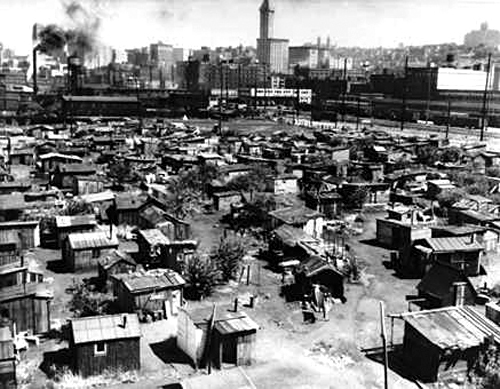
Rather than filtering down, these rudimentary settlements had and have a tendency to "filter up" internally, as residents gained a foothold economically and improved their dwellings.  For most Americans, the best-known of these types of areas are the so-called "Hoovervilles" of the Depression era, when the unemployed and rural migrants occupied low-value or underused land near city centers:

Seattle, WA in the 1930s. Source.
These crude shacks offered little more than shelter from the elements, but they were the result of people in dire situations doing the best they could with what they had available.  Governments then and now refused to accept this reality and, rather than trying to improve the conditions within these settlements, generally favored mass eviction and demolition.  In an interesting twist, this style of development has been rediscovered by contemporary American cities (particularly Seattle), and, without apparent irony, has been rebranded as the "tiny house village."

Beyond housing for the very poorest of the poor, American cities through at least the 1920s built in bulk for the lower end of the income scale.  This housing took several forms:
  • As noted above, shanty housing built by those with little or no experience in construction.
  • Small, temporary and/or transient housing, such as flophouses, boarding houses and other manner of SRO rentals.
  • Small multifamily housing wherein a person of some means would build a home with one or two attached apartments which could be let out at low cost.  Often these apartments would be sub-let to boarders who might occupy a single bedroom.
  • Self-built housing of a higher quality, which might be built from a Sears housing kit, or by a person with some background in construction.  One study estimates as many as 1 in 5 American homes were self-built in the 1920s.
  • As noted in the comments, company towns and other housing built by large businesses for their workers to inhabit. 
The first, second and third of these options were virtually outlawed starting in the 1920s and in the decades following.  What changed during and after the 1920s was not the market's willingness or ability to continue constructing such housing, but society's tolerance for housing of perceived low quality or of profitable use.   The Housing Act of 1937, for instance, was not so much concerned with ensuring affordable housing for the poor, but rather with "the provision of decent, safe and sanitary dwellings for families of low income and the eradication of slums."  Single-room rentals did not fit into this well-meaning but upper middle-class vision.

The "eradication of slums" element of this strategy was more faithfully carried out then the provision of dwellings, and in the process much of the evidence of the low-income neighborhoods of the pre-1950 period was obliterated.  Municipal archives may contain photographic documentation of the condemned neighborhoods, as in the case of Nashville, below, showing a street of tin-roofed shotgun houses and very modest bungalows built in the early 20th century for lower-income tenants.  All were "eradicated" in the 1960s along with much of the surrounding neighborhood and their residents dispersed elsewhere.  That many of these neighborhoods were demolished or saw demand for them fall to near zero, with resultant abandonment, should not cause us to forget they ever existed.

Nashville houses circa 1960; all demolished in urban renewal.  Courtesy MDHA.
It might not be going to far to say that the traumatic process of urban renewal instigated an involuntary filtering, as residents of the poorest areas were literally displaced -- cast out of condemned homes -- and forced to seek new housing from among a diminished housing stock.  These people probably did move into somewhat higher-quality housing, but at higher cost and possibly in more crowded conditions as well.

But what of the fourth type of housing, the proper self-built house?  As it turns out, there was a crackdown on this type of housing as well for reasons that seem to have had less to do with ensuring decent and sanitary housing and more to do with disreputable and exclusionary motives.  The impetus for these changes may have been the mobility provided by the automobile.  I'll quote from one book at length which describes one town's legislative action against black self-builders in Ohio, including one Eddie Strickland:
"In 1946 ... in a series of irregular meetings, the council [of the town of Woodmere, Ohio] passed a building code aimed at restricting do-it-yourself builders, among whom blacks were a prominent group. The code mandated a maximum one-year time limit for the construction of new homes, forbade secession of work for any period longer than forty-eight hours, and prohibited the use of secondhand building materials. Finally, the code required builders to post a $1,000 bond to ensure compliance..... 
"By lifting construction standards (and allegedly enforcing regulations in a discriminatory manner), Woodmere officials raised the cost of home building in the village and substantially limited settlement by working-class blacks. Moreover, the passage of similar building restrictions throughout the county helped limit the number of African American suburbanites in the Cleveland area. The trend had an apparently chilling effect on the attendance of blacks at the weekly land auction in Cleveland, where a number of families had formerly purchased suburban land for delinquent taxes.... 
"Far from being an isolated event, Strickland's confrontation with authorities in Woodmere reflected a national trend toward regulation of the suburban fringe that hastened the decline of working-class suburbanization in the postwar decades. In Cleveland and other metropolitan areas, the proliferation of suburban municipalities led to the extension of land-use regulations to formerly unregulated areas. Zoning and building codes curtailed informal home building and inflated the cost of a suburban home. Racist application of these regulations closed the door on development for blacks, and the enforcement of sanitary regulations led to the demolition of existing black housing and restrictions on domestic production. 
Excerpt from Places of Their Own: African American Suburbanization in the Twentieth Century by Andrew Wiese
Disputes over self-built homes continue to arise today in remoter regions, as seen in the recent lawsuit brought on behalf of Amish homebuilders in upstate New York who were being required by local codes to submit architectural plans and install other expensive features in their self-built farmhouses.  The elimination of the self-built home as an affordable option in much of the country, in conjunction with zoning regulations limiting small multifamily housing, setting minimum lot sizes and imposing other similar restrictions, completed the elimination of the lower rung of prior housing options.  Left were only the newer mobile/prefab home, which partly stepped in to fill the gap that had been left, and the filtering process, which though demonstrably effective was not always rapid enough to insure a sufficient quantity of housing nor sufficiently cheap housing, especially in cities with high residential demand.

Of these two options, mobile homes were heavily restricted in where they could be located, and urban renewal destroyed huge quantities of filtered housing, i.e., "blighted" homes.  The result is a market which appears, artificially, not to create low-income housing options.

Is this article a call for the return of flophouses, then?  Not in the sense of the negative and unsanitary associations of that term and other like it, but in the sense of a government which recognizes that these older types of housing represent the market's effort to meet vital needs, and that regulation can help meet these needs in a safe and sanitary way without taking an adversarial approach toward them.  These market approaches can be complementary to public housing investments and other public assistance programs, as well, rather than being seen as inferior alternatives.  The tiny house village movement mentioned earlier is one such manifestation of this approach, and shows that the political obstacles need not be insurmountable.

Other and related reading:

Saturday, March 21, 2015

Single Family Zoning: It's All About the Lot Sizes

Contemporary critiques of zoning take several forms.  First, and probably most common, is the critique of strict use segregation in the Euclidean manner, with commercial and residential areas segregated to greater or lesser degrees.  An increasing focus has lately been placed on the relative preponderance of single-family detached residential zoning within urbanized areas.  A third line of critique, which has received somewhat less attention although it has been the subject of numerous academic studies over the years, looks at minimum lot size requirements within both single-family and multifamily zones.

Although it may seem like a minor subject next to the first two critiques mentioned, the second critique is incomplete without examining permitted lot sizes.  For instance, even though a city may have substantial areas set aside for multifamily housing, if the minimum lot size per apartment unit (or floor area ratio equivalent) is approximately equivalent to single-family zones, the density and/or affordability difference may be minimal.  Alternatively, the single-family detached ("SFD") zoning designation, by itself, tells us little about the density of the area.  Depending on the lot area required and right-of-way widths, SFD densities for a given household size can range from 300/square mile to as much as 25,000/square mile or more, all without the need for any party walls.  

A few concrete examples can help illustrate the point.  In the American context, despite the presumed consumer preference for SFD homes, neighborhoods of homes on very small lots and using narrow rights-of-way, such as are abundant in many other countries, are quite rare.  In the entire New York metropolitan area, for instance, there are only a handful of such neighborhoods, mostly those intended as beachside retreats along the southern shore of Brooklyn and on the Rockaway Peninsula.  One such neighborhood is shown here:


This is Gerritsen Beach, in Brooklyn, showing parcels of 1,800 square feet on a right-of-way (property line to property line) of 28'.  The 2010 Census gives a population density of over 17,000/square mile, about half of the average for Brooklyn, although this may be affected by the presence of second homes.  As Nathan Lewis has shown, similarly scaled neighborhoods in Tokyo attain densities exceeding 30,000/square mile.  Even so, it is about 80% denser than the densest SFD suburbs built in Nassau County during the 1940s-1970s.  It is more than twice as dense as Levittown itself, and denser even than the three-decker neighborhoods of cities like Worcester, MA or New Haven, CT.  The New York metro area has a conspicuous absence of neighborhoods of this density and type, with Census tracts swiftly falling off from around 25,000/square mile to 10,000/square mile.

Beach neighborhoods seem to be popular settings for this type of design, as a similar (but slightly lower) density is present in Long Beach, California, shown below.  Lots are around 2,400 square feet with a 40' right of way and alleys of 13' (comparable density appears to be achieved through presence of small apartment buildings):  


And here is Levittown itself, with lot sizes of around 6,000 square feet and right-of-way (between outer sidewalk edges) of 50'.  Population density is approximately 7,500/sq. mi.:  


The Levittown homes in their initial form, intended for the large families of the Baby Boom era, were actually somewhat smaller (800 sq. ft.) than the 1920s vacation cottages of Gerritsen Beach (1,000 sq. ft.).  The contrast of very small houses with lots the same size or larger larger than those typical of the pre-1940 period seems to have been characteristic of the time period, perhaps related to the increased cost of labor following the Great Depression combined with stable land values.  The more spacious lots may have offered some compensation for the modest interiors.

At the extreme is the ultra-low density of interior but non-rural New England, showing 2- and 3-acre lot zoning (here, in Easton, Connecticut), accompanied by wetlands regulations, with population density of around 260/square mile:


Now, if a rapidly urbanizing country wished to offer the possibility of ownership of a SFD home to the greatest possible portion of its population, the obvious policy goal would be to allow construction of a SFD home on any size lot desired, and on streets as narrow as possible so as to minimize economic waste.  The result is very much what we see in most of the wards of Tokyo as well as in Gerritsen Beach: very small lots but with practical (square-shaped) dimensions along narrow streets and no alleys.  Where multifamily buildings are not prohibited, these will be interspersed here and there, sometimes occupying two or three lots.

In practice, however, American zoning does not take this approach, with the sole exception of mobile home parks (which I've discussed here).  Not only are lot sizes strictly regulated for SFD zones, generally to standards far in excess of what is needed for a comfortably-sized home, other policy measures are in place that make small lots difficult to build as a matter of economics, such as:
  • Apparent aesthetic preference for large, widely space multifamily over densely packed single-family in multifamily zones.  Although small multifamily buildings have fallen out of zoning fashion, if they were ever popular, those zones that survive have some curious features.  For instance, one Connecticut town's code, typical of the type, effectively grants density bonuses for building duplexes and triplexes over building two or three standalone houses on the same lot.  In the densest zone it is possible to build a single-family home on 5,000 sq. ft. -- the smallest SFD lot permitted in any zone -- but a duplex requires only 7,500 sq. ft. and a triplex only 9,000.  The policy intent here is not obvious, but implies aesthetic favoritism for retaining large dwellings with generous spacing even at the expense of the single-family ideal.  
  • Minimum street widths.  Although these do not affect the lot size directly, mandated wide streets make small lots for SFD a less economical proposition.  For instance, were the Gerritsen Beach lots placed along the Levittown right-of-way, each 1800 sq. ft. lot would look out onto 3,000 sq. ft. of sidewalk and roadway!  The neighborhood, overall, would have a ratio of 1.2:1 of private land to right-of-way, or, in other words, only 55% of the land would be in private lots for sale.  Levittown's ratio is a far better 3:1.  With a 28' right-of-way, Gerritsen Beach's streets are already about as wide as economically possible in light of high land values, and streets of Japanese dimensions would yield a far better ratio.
The design differences produce some noticeable differences even at the very large scale.  The prefecture of Tokyo, with population 13.2 million, has a homeownership rate of 45%.  The city of New York, with population 8.4 million, has homeownership of 32%.  Although the prefecture's density is lower than New York's (16,000 vs. 28,000/sq. mi.), Tokyo's outer suburban areas are so much denser than New York's that its metropolitan area density is higher.  For the entire metro area, Tokyo maintains a 56% homeownership rate with 47% share of detached houses, as compared to New York with 52% homeownership and 36% SFD share.  Los Angeles, to pick another example, has 49% homeownership with 50% SFD stock.

A metro area of more comparable size to New York's, such as Kyoto-Osaka-Kobe, has a homeownership rate of 58%, higher than the entire state of New York, and not much lower than far smaller American cities commonly associated with low-density SFD housing such as the Houston MSA (60%), Dallas (61%), Atlanta (63%) and Phoenix (63%).

Interestingly, the issue of minimum lot sizes appears to be one on which there is general agreement between the Smart Growth faction and the defenders of suburbia, as Wendell Cox wrote some years ago in response to critique from the Brookings Institute:
"I was even more surprised at the claim that I defend 'anti-density zoning and other forms of large lot protectionism.' Not so. 
Indeed, I agree with [Jonathan] Rothwell on the problems with large lot zoning. However, it is a stretch to suggest, as he does, that the prevalence of detached housing results from large lot zoning. This is particularly true in places like Southern California where lots have historically been small and whose overall density is far higher than that of greater New York, Boston, Seattle and double that of the planning mecca of Portland."
I think that Cox is correct here, but not even as correct as he could be.  Large-lot zoning not only does not cause a prevalence of SFD housing, it limits it, as shown in the New York metro area.  Los Angeles' metropolitan density is substantially higher than New York's (a point often raised to incredulous reaction), but its share of SFD stock is much higher.  To point out in response to an allegation that a city is heavily zoned for SFD that a majority of its housing units are in multifamily structures (in the case of Seattle, at the link) only underscores the point.

Although most studies have found that minimum lot sizes do affect overall development density (that is, developers appear to build at or near the minimum lot size allowed), one study of Maryland suburbs of Washington, D.C. found that, except in the case of areas with very large minimum lots sizes, developers were subdividing into lots larger than the mandated minimum, including in cases where planned unit development options left them with a free hand to build denser than the zoning code superficially allowed:
"We then examine the extent to which lot size is being constrained by regulation by comparing actual subdivision density to the allowable density under zoning rules. This analysis is done for three counties with different degrees of suburbanization. We find that only in the areas with the very large lot zoning does zoning seem to be constraining actual lot[] size. There is a good deal of excess capacity in the density that could be built, especially in the more densely zoned areas." Lot Size, Zoning, and Household Preferences:Impediments to Smart Growth?
There might be no concern with low-density development at the fringes of metro areas except that such areas, once built up, are politically almost impervious to change.  Some cities have implemented maximum lot sizes, but these are generally very generous and only apply in certain areas.  The misunderstood achievement of the New Urbanism, and the Maryland suburb of Kentlands in particular -- whatever its faults in design detail -- was that small lot single-family housing developments not only need not be qualitatively inferior to the 6,000+ sq. ft. tracts that characterized the post-1940 suburban era, and that they could even offer amenities that made them superior residential environments.  Where regulatory mandates fail, leading by example can succeed.

Kentlands, with SFD lots from 5,600 to 2,600 sq. ft, and with ROWs ranging
from 45 ft. to 12 ft. on alleys.
Related posts: None of mine, but Nathan has written several great pieces on the topic which you can find at his website.

Sunday, March 8, 2015

Auto Costs and Housing Costs, or, One Reason the Suburbs are So Appealing

Simon Vallee has a post from some time back about filtering vs. gentrification in which he analogizes the process of gentrification, in North America, to the car market in Cuba, noting that restrictions on supply will tend to boost prices and limit availability of a desired good.  Although the comparison is intended to be illustrative, I think it also highlights a substantive difference which, in effect, subsidizes automobiles at the expense of housing.  First, though, some background.

Going back for a moment to the subject matter of a Nathan Lewis post, we can note that, land costs aside, the sticker price of manufactured housing as compared to a new vehicle is not as different as one might think.  A two-bedroom manufactured home, for instance, of about the size of the average new home of the 1950s, costs only around $41,500 as compared to the price of a popular new sedan (I chose the Altima, one of the best-selling cars in the United States) at around $27,000:


However, when car costs are compared to overall home values, including site-built as well as manufactured homes, a different story emerges.  In 1940, the median home was valued at only 2.3 times the retail price of the average new car.  By 2010, in spite of the crash in home prices, this ratio had risen to 6.4.  Car operating costs have also generally fallen as fuel efficiency and vehicle reliability have improved.  Median rents, not shown here, have grown at an even faster rate than home values.

In short, over the last seven or so decades, car ownership (or leasing) has become dramatically less expensive relative to home ownership or tenancy.  Partly this must be due to labor-saving technologies that have affected car production more than homebuilding: even manufactured homes still require extensive human labor, which has become much costlier (though more productive) since 1940, whereas the formerly labor-intensive car assembly process has been heavily automated and accelerated.  The process of robotically assembling houses, or even apartment buildings, remains in its infancy.

Are long-term, over-inflation increases in home values also linked to increases in land values caused by general urban population increase and restrictive zoning?  It goes without saying that rural land values are lower than urban land values, and the Census homeownership figures show that housing values are lower, and homeownership higher, in more rural states in spite of lower incomes.  Relatively poor and rural West Virginia has the nation's highest homeownership rate, while 100% urbanized Washington D.C. has had its lowest in every Census since 1930.  As Luis Bettencourt writes:
"There are several important consequences for general land use in cities. First, the price of land rises faster with population size than average incomes. This is the result of per capita increases in both density and economic productivity, so that money spent per unit area and unit time, i.e. land rents, increases on average by 50% with every doubling of city population size! It is this rise in the price of land that mediates, indirectly, many of the spontaneous solutions that reduce per capita energy use and Carbon emissions in larger cities. Cars become expensive to park, and taller buildings become necessary to keep the price of floor space in pace with incomes, thus leading to smaller surface area to volume."   The Kind of Problem a City Is.
Urbanization in the era of the automobile in turn causes frictions which lead to pressure for zoning.  American municipal zoning, in its initial formulation and as is still practiced today, is fundamentally a device to politically manage these frictions by restricting the intensity of residential land use.  Though not its stated purpose, it has the effect of increasing land scarcity that is already inherent in the urbanization process, and thereby provides a positive feedback mechanism that puts additional pressure on housing values.

What does this all have to do with cars?  As noted above, the cost of a manufactured home, in isolation, is only slightly more than that of a typical sedan.  As urbanization increases, however, the increasing value of land makes cars, which do not have their land storage cost bundled into the sticker price (unlike Japan does, effectively), seem like a relative bargain.  Some time ago, Cap'n Transit wrote a fascinating series on how New York came to tolerate and eventually permit free overnight on-street parking in the late 1940s and early 1950s.  We would find it ludicrous if someone were to purchase a manufactured home and to drive it into Manhattan on a flatbed expecting the city to provide free land on which to site it, but that was how the story went with cars:
"This [middle-class] conception of the benefits of car ownership has always had a huge bait-and-switch component to it. In New York City in the 1940s it was no exception. When people looked at the price of a car, they didn't figure in $20-35 per month in garage rental. When they got their cars, many couldn't afford to pay and took their chances on the street. Garage owners now had to compete with free street parking and lowered their rates accordingly, which meant that they didn't have enough income to expand their facilities, and resorted to bribing the police. 
"These social-climbing drivers felt cheated, but they didn't take their anger out on the car dealers. No, they felt that the city owed them the free parking necessary to make their cars as affordable as they thought." The right to free parking in 1940s New York
There are therefore two clashing trends: as cities grow in size, the cost of a buying a car declines relative to increases in income and housing cost, yet the actual cost of storing a vehicle is, or should be, increasing rapidly, since cars, like houses, occupy a significant amount of valuable space.  Rather than taking the common-sense Japanese approach of the shako shomeisho (proof of parking), however, American states and cities have engaged in onerous mandatory inclusionary zoning for cars (parking minimums), zoning exemptions (e.g. not counting garages toward FAR limits and allowing parking, but not housing, in mandated setbacks), tax exemptions (only 16 states maintain a personal property tax that covers automobiles) and fringe benefits (the commuter parking benefit), in addition to rent-free public housing for cars (overnight on-street parking).  Whereas in 1940, buying and operating a car to escape urban housing costs simply shifted the balance of expenses, with a car costing almost half as much as the median home, in 2010 the prospect of doing so was much more economically feasible.  No doubt many of those New Yorkers of the 1940s and 1950s eventually drove those cars out of their subsidized parking spaces and off to the far reaches of Nassau, Bergen and Westchester Counties, and who could blame them?

Perhaps the biggest effect of all though, going back to the beginning of the post, relates to the obvious but important point that while housing production, and particularly in-city housing production, is subject to political constraints, car production is not (well, mostly not).  There even seems to be a difference in Americans' moral characterization of those who build homes and cars for profit: while a search for the phrase "greedy developers" returns over 60,000 hits, "greedy automakers" returns only 1,000.  From that perspective, the so-called "drive 'til you qualify" phenomenon, much questioned and criticized, is an entirely reasonable response to this economic reality, particularly given widespread lack of highway tolls. 

Making a full accounting of the political choices that have been made with regard to both housing and transportation is a daunting task, but it does help illuminate the residential patterns we see without the need to resort to moral judgments about those choices.

Related posts: Was the Rise of Car Ownership Responsible for the Midcentury Homeownership Boom in the US?

Saturday, October 4, 2014

Housing Innovations in Texas

Citylab recently posted an interesting profile of a new development in Harlingen, Texas by Amanda Kolson Hurley.  Having written about this area of the country earlier this year, I was curious to take a closer look at the development, which appeared to take some design cues from the Mexican urbanism that is just a short ride away from this border region.

An aerial view of the development, La Hacienda Casitas, shows it set among mobile home parks that are very common in Harlingen.  These homes, however, are site built, and use lots as small as 1,800 square feet, which is similar to the lots sizes found in the new developments of Matamoros, Mexico.  Streets range from 16 to 22 feet wide, with some on-street parking:


The more I looked around Harlingen, the more this particular development stood out: overwhelmingly, new development in the city consists either of mobile home parks or much larger suburban homes of the type found in sunbelt cities across the United States.  It was a pattern I'd seen before, in Bradenton, Florida, where the city's zoning code divided single-family housing into two types: large lot, site-built suburban and small-lot, manufactured and/or mobile.  Could land use in Harlingen be governed by similar provisions?

Fortunately, the city puts its zoning ordinance and map online in an easy-to-navigate format, so finding residential lot minimums was not difficult:


Here we see that Harlingen, like Bradenton, establishes a minimum lot size for lots in mobile home parks that is less than half that required in the single-family "R1" zone.  In fact, the ratio between the two zoning categories is nearly the same in both cities (Harlingen: 6000/2400 = 2.5 vs. Bradenton: 7200/3000 = 2.4).  Unlike Bradenton, Harlingen does not seem to establish minimum sizes for the dwellings themselves, although setback and lot coverage requirements impose effective maximums that are most restrictive on very small lots.

How well the city holds developers to the limits I cannot say for sure, although most lots in developments platted within the last 20 years appear to be between 6,000 and 7,000 square feet. On first blush the "Planned Development" zone appears to provide some flexibility, but it requires the developer to own a parcel of at least five acres, leaving it unavailable to small-scale builders designing infill projects.  Townhouses are also an option, but are not permitted by right in R1 zones.

In any event, the disparity between zones again appears to create a binary pattern of real estate prices, with new site-built homes on large lots averaging around $145,000, and manufactured homes only $45,000 or so.  Thanks to zoning-abetted filtering*, some site-built homes can be bought for no more than $60,000 to $70,000, but these tend to be of very low quality or on much smaller lots that seem to have been grandfathered in under the present zoning code.  This mandated land consumption obviously contributes to a low-density pattern of urban growth, and also illustrates how zoning's affordability and quality of life impact isn't limited to large coastal metros.  Harlingen's affordability safety valve, the mobile home district, establishes what is in effect a physically segregated zone for low-income, market-rate housing where even the homes themselves are forbidden from being site-built.

Homes in La Hacienda Casitas. Credit: bcWorkshop.
In light of all this, was the La Hasienda Casitas project an attempt to circumvent the code with a development of houses on tiny lots and narrow streets, thereby making occupancy (the homes appear to be rentals, at least for now) of new, freestanding and site-built homes available to low-income families of Harlingen?  Kolson Hurley's article discusses the intensive coordination and grant-seeking between and among architect bcWorkshop and non-profit housing developer Community Development Corporation of Brownsville needed to bring the project to fruition, but I have to wonder whether regulatory barriers, rather than anything inherent in the design and construction of this project, is what is standing in the way of adoption of the style by for-profit developers.


*Zoning-abetted in that the restriction of centrally-located lots to single-family use effectively caps land values, allowing the physical deterioration of the housing stock to play the predominant role in establishing property values.

Related posts:
Mobile Home Impediments and Opportunities
Cross-border Urbanism: From Texas to Tamaulipas

Tuesday, March 11, 2014

Housing Dreams, American and Mexican

In the previous post, I observed how newly-built single-family housing in the Mexican border city of Matamoros (and in fact in most Mexican cities) is both much smaller in size and far cheaper, even adjusting for lower incomes, than almost any housing in the United States outside of Detroit.

New Matamoros rowhouses. (Google Maps).
This is partially due to the underdevelopment of the mortgage banking industry in Mexico, with the result that six percent of all homes in the country are financed with mortgages. The vast majority of homes are either inherited, bought with cash, or else are self-built on cheap vacant land, although informal lending systems among friends and family members no doubt lie behind many of these cash purchases. In the absence of debt-financed home consumption, most new homes must be very modest to match the limited purchasing power of potential buyers. 

Although one might expect this lack of financing to impair individual property ownership, a surprising 80 percent of Mexicans own their own homes. This compares to a rate of only 65 percent in the United States, where 70 percent of homes are encumbered with mortgages and only 1 in 10 buyers pays in cash (at least, until the recent surge in buying by institutional investors). As I pointed out in a previous post, the homeownership rate in the US has actually been more or less stagnant since the mid-1960s in spite of extraordinary efforts to expand the availability of credit.

I think there is something else at work here, though, beyond the influence of two very different lending environments, and it relates back to the modest size of houses observed in Mexican cities. It's been a point often noted that the average size of new American homes has been steadily increasing since 1950 even as household sizes have fallen. Home sizes and household sizes have diverged so sharply, in fact, that a major structural mismatch has emerged throughout the US housing market, as shown below (charting percentages of all US housing units and all US households):

Data from 2012 ACS three-year estimates.
Although over 60% of US households consist of just one or two people, only 13% of housing units are studios or have one bedroom. Moreover, we know that very few single-family homes of the type produced over the past few decades years have been studios or one bedrooms (or even two bedrooms), making it likely that most of these units are apartment rentals. This can be confirmed through housing data on tenure status, which show that studio and one bedroom units are overwhelmingly renter-occupied:

Data from 2012 ACS five-year estimates.
Homeownership in the United States, evidently, is very much a large or larger-home phenomenon (assuming that number of bedrooms is a reasonable proxy for housing unit size). When owned units are looked at in isolation, this fact becomes even more startling:

Data from 2012 ACS five-year estimates.
In essence, new single-family detached or attached homes intended for just one or two people, of the size built in mass quantities in Mexico, virtually do not exist in the United States. A Zillow or Trulia search in most any major American city will quickly show that this type of home largely ceased being built after the late 1950s, which, perhaps not entirely coincidentally, is about the same time that the homeownership rate began to level off. Today, only about one in ten new single-family homes have two or less bedrooms. Although this might be understandable if the decline had been offset by significant increases in the proportion of small units in multifamily buildings, it turns out that this has not been the case.

To what extent these patterns are an expression of consumer preferences, market forces, financial and tax incentives and/or land use restrictions (such as minimum lot or square footage restrictions) is unclear, although there is evidence that square footage restrictions generally seem to have appeared at around the same time as smaller homes ceased being built in large numbers and to have increased in restrictiveness thereafter.* Very small houses, and very small lots, have in typical American zoning fashion been segregated and stigmatized in so-called trailer parks (note that Matamoros, despite being poorer than any American city, apparently has no trailer parks).
Tiny House movement circa 1921:
"Just the thing for two people!"

Whatever the explanation, the effect must be to impede further increases in homeownership. As the country has undergone a long-term reduction in household size, the market has produced fewer and fewer for-sale options sized for small households. The options that remain are not ideal. One can either buy a home that is far larger and more expensive than one needs or enter a competitive rental market for legally restricted multifamily supply (large swaths of American cities, due to restrictive zoning, have few or no apartments for sale at all). An additional option  subverting late 20th century cultural norms* by renting out rooms within a single-family dwelling larger than needed for just one or two occupants  invariably raises the hackles of incumbent homeowners (as seen in the occupancy limit controversy in Austin and many other cities).

These trends have been noted countless times before, in particular by Christopher Leinberger, while Nathan Lewis has been adamant about the need for an increase in production of much smaller homes (including multifamily construction) and, just as importantly, the availability of much smaller building lots. Americans seem to have some difficulty conceptualizing separately-owned very small homes on small lots, though, and even when structures of this size are recognized as meeting an important market need, they are typically imagined as mere accessories to "proper" single family homes, not least by the New Urbanists themselves. Still, that is an approach that tries make something better out of the traditional American pattern of building a series of small houses (on their own separate street network!) just for cars to live in:

Indianapolis residential alley with garages, origin ca. 1920s. (Google Maps).
The Tiny House movement, which partly emerged in reaction to the financial burden imposed by large homes, has no such hang-ups, though the emphasis seems to be almost exclusively on shrinking the size of the home, rather than the size of the lot, and is often associated with rural environments (though certainly not always, and also see here). But large houses seem to be a natural fit for oversized lots and overbuilt infrastructure, as Nathan Lewis has noted.

What would be a reasonable price goal, within the context of the dominant single-family detached form, for housing cost using both small homes and small lots? Nathan, in his writings on this subject, aims for $50,000, which, when adjusted for higher American incomes, would be roughly comparable to the greenfield homes of Matamoros. Nick Derome estimated $170,000 for very small-lot homes in surburban Toronto in comments on the previous post. For even the highest cost towns in Fairfield County, Connecticut, based on land prices, 1,000 sq. ft. homes of less than $200,000 appear financially (if not politically) feasible. Going almost anywhere else from such a high cost location, prices should drop significantly.

Even within certain parts of ultra-expensive Fairfield County itself, the few manufactured and/or mobile homes available for sale (the only type of contemporary single-family detached housing that, with its special zoning designation, has anywhere close to the lot sizes found in Matamoros) tend to run around $60,000 for a 1,000 sq. ft., two-bedroom home. Higher quality architecture and construction  such as that found on the Katrina cottages or better — could surely be provided at only somewhat greater expense. A major challenge, it would seem, is not simply surmounting legal barriers, but reaching an understanding that small homes are not just for poor families, but for small families and others too.

--------------------------------

Related posts: It turns out I'm not the first to connect Tiny Houses and Mexican urbanism -- an American homebuyer in the Mexican city of Merida linked the two on his blog here. Also, Life Edited opines on Why Household Size Matter and Why Are American Homes So Big?

*In striking down a Connecticut town's law fixing the minimum home size at 1,300 square feet (under challenge by a builder attempting to construct a 1,000 sq. ft. modular home), the Connecticut Supreme Court noted "the significant increase of the minimum floor area requirements over the years since 1955 when [the town] had its first regulation controlling minimum floor area requirements. At that time, the minimum floor area requirements were only 750 square feet for a one-story house... ." Builders Service Corporation v. Planning & Zoning Commission (1988). Similar New Jersey ordinances dated as early as 1949.

*Consider the connotations of the very term "single-family dwelling" and what it implies about the identity of the inhabitants of such a dwelling. However, such creative use of single-family dwellings used to be very common, legal and accepted as more or less ordinary (for an example, browse the appendix of the 1950 Housing Census, which describes a bewildering array of housing arrangements within a single home that enumerators might encounter).