Showing posts with label Mobile Homes. Show all posts

Sunday, December 27, 2015

When the Market Built Housing for the Low Income

In a recent post, Daniel Kay Hertz examines residential filtering, the process by which housing units depreciate and therefore become available to lower-income buyers or renters over time.  In particular, Hertz examines a Stuart Rosenthal article on the phenomenon which I have examined critically here and here. Although he makes the very good point that the filtering process is not operating in unhindered fashion in many large American metros, he also makes the claim, which I have seen in many other contexts and by other authors, that "very little private housing in the United States was originally built for low-income people."

Although this may be somewhat accurate so far as it only applies to formal housing developers, throughout the history of American cities and indeed most other cities in the world, a large portion of the housing stock came from the informal economy, most of it purpose-built for indigent migrants or very poor laborers.  This was the case even in some of the largest and wealthiest cities in the Western world until fairly recently.

In the typical city, such housing would (and is) either be found on the outskirts or on very low-value urban sites, such as floodplains, rocky ground or steep slopes.  Infrastructure was poor and public services were minimal or nonexistent.

American Favela: The "Dutch Hill" area of midtown Manhattan in 1863.  Source here.
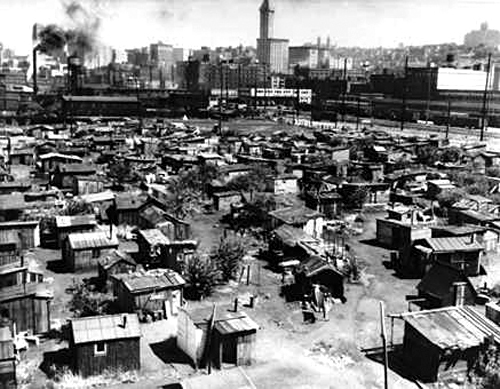
Rather than filtering down, these rudimentary settlements had and have a tendency to "filter up" internally, as residents gained a foothold economically and improved their dwellings.  For most Americans, the best-known of these types of areas are the so-called "Hoovervilles" of the Depression era, when the unemployed and rural migrants occupied low-value or underused land near city centers:

Seattle, WA in the 1930s. Source.
These crude shacks offered little more than shelter from the elements, but they were the result of people in dire situations doing the best they could with what they had available.  Governments then and now refused to accept this reality and, rather than trying to improve the conditions within these settlements, generally favored mass eviction and demolition.  In an interesting twist, this style of development has been rediscovered by contemporary American cities (particularly Seattle), and, without apparent irony, has been rebranded as the "tiny house village."

Beyond housing for the very poorest of the poor, American cities through at least the 1920s built in bulk for the lower end of the income scale.  This housing took several forms:
  • As noted above, shanty housing built by those with little or no experience in construction.
  • Small, temporary and/or transient housing, such as flophouses, boarding houses and other manner of SRO rentals.
  • Small multifamily housing wherein a person of some means would build a home with one or two attached apartments which could be let out at low cost.  Often these apartments would be sub-let to boarders who might occupy a single bedroom.
  • Self-built housing of a higher quality, which might be built from a Sears housing kit, or by a person with some background in construction.  One study estimates as many as 1 in 5 American homes were self-built in the 1920s.
  • As noted in the comments, company towns and other housing built by large businesses for their workers to inhabit. 
The first, second and third of these options were virtually outlawed starting in the 1920s and in the decades following.  What changed during and after the 1920s was not the market's willingness or ability to continue constructing such housing, but society's tolerance for housing of perceived low quality or of profitable use.   The Housing Act of 1937, for instance, was not so much concerned with ensuring affordable housing for the poor, but rather with "the provision of decent, safe and sanitary dwellings for families of low income and the eradication of slums."  Single-room rentals did not fit into this well-meaning but upper middle-class vision.

The "eradication of slums" element of this strategy was more faithfully carried out then the provision of dwellings, and in the process much of the evidence of the low-income neighborhoods of the pre-1950 period was obliterated.  Municipal archives may contain photographic documentation of the condemned neighborhoods, as in the case of Nashville, below, showing a street of tin-roofed shotgun houses and very modest bungalows built in the early 20th century for lower-income tenants.  All were "eradicated" in the 1960s along with much of the surrounding neighborhood and their residents dispersed elsewhere.  That many of these neighborhoods were demolished or saw demand for them fall to near zero, with resultant abandonment, should not cause us to forget they ever existed.

Nashville houses circa 1960; all demolished in urban renewal.  Courtesy MDHA.
It might not be going to far to say that the traumatic process of urban renewal instigated an involuntary filtering, as residents of the poorest areas were literally displaced -- cast out of condemned homes -- and forced to seek new housing from among a diminished housing stock.  These people probably did move into somewhat higher-quality housing, but at higher cost and possibly in more crowded conditions as well.

But what of the fourth type of housing, the proper self-built house?  As it turns out, there was a crackdown on this type of housing as well for reasons that seem to have had less to do with ensuring decent and sanitary housing and more to do with disreputable and exclusionary motives.  The impetus for these changes may have been the mobility provided by the automobile.  I'll quote from one book at length which describes one town's legislative action against black self-builders in Ohio, including one Eddie Strickland:
"In 1946 ... in a series of irregular meetings, the council [of the town of Woodmere, Ohio] passed a building code aimed at restricting do-it-yourself builders, among whom blacks were a prominent group. The code mandated a maximum one-year time limit for the construction of new homes, forbade secession of work for any period longer than forty-eight hours, and prohibited the use of secondhand building materials. Finally, the code required builders to post a $1,000 bond to ensure compliance..... 
"By lifting construction standards (and allegedly enforcing regulations in a discriminatory manner), Woodmere officials raised the cost of home building in the village and substantially limited settlement by working-class blacks. Moreover, the passage of similar building restrictions throughout the county helped limit the number of African American suburbanites in the Cleveland area. The trend had an apparently chilling effect on the attendance of blacks at the weekly land auction in Cleveland, where a number of families had formerly purchased suburban land for delinquent taxes.... 
"Far from being an isolated event, Strickland's confrontation with authorities in Woodmere reflected a national trend toward regulation of the suburban fringe that hastened the decline of working-class suburbanization in the postwar decades. In Cleveland and other metropolitan areas, the proliferation of suburban municipalities led to the extension of land-use regulations to formerly unregulated areas. Zoning and building codes curtailed informal home building and inflated the cost of a suburban home. Racist application of these regulations closed the door on development for blacks, and the enforcement of sanitary regulations led to the demolition of existing black housing and restrictions on domestic production. 
Excerpt from Places of Their Own: African American Suburbanization in the Twentieth Century by Andrew Wiese
Disputes over self-built homes continue to arise today in remoter regions, as seen in the recent lawsuit brought on behalf of Amish homebuilders in upstate New York who were being required by local codes to submit architectural plans and install other expensive features in their self-built farmhouses.  The elimination of the self-built home as an affordable option in much of the country, in conjunction with zoning regulations limiting small multifamily housing, setting minimum lot sizes and imposing other similar restrictions, completed the elimination of the lower rung of prior housing options.  Left were only the newer mobile/prefab home, which partly stepped in to fill the gap that had been left, and the filtering process, which though demonstrably effective was not always rapid enough to insure a sufficient quantity of housing nor sufficiently cheap housing, especially in cities with high residential demand.

Of these two options, mobile homes were heavily restricted in where they could be located, and urban renewal destroyed huge quantities of filtered housing, i.e., "blighted" homes.  The result is a market which appears, artificially, not to create low-income housing options.

Is this article a call for the return of flophouses, then?  Not in the sense of the negative and unsanitary associations of that term and other like it, but in the sense of a government which recognizes that these older types of housing represent the market's effort to meet vital needs, and that regulation can help meet these needs in a safe and sanitary way without taking an adversarial approach toward them.  These market approaches can be complementary to public housing investments and other public assistance programs, as well, rather than being seen as inferior alternatives.  The tiny house village movement mentioned earlier is one such manifestation of this approach, and shows that the political obstacles need not be insurmountable.

Other and related reading:

Saturday, October 4, 2014

Housing Innovations in Texas

Citylab recently posted an interesting profile of a new development in Harlingen, Texas by Amanda Kolson Hurley.  Having written about this area of the country earlier this year, I was curious to take a closer look at the development, which appeared to take some design cues from the Mexican urbanism that is just a short ride away from this border region.

An aerial view of the development, La Hacienda Casitas, shows it set among mobile home parks that are very common in Harlingen.  These homes, however, are site built, and use lots as small as 1,800 square feet, which is similar to the lots sizes found in the new developments of Matamoros, Mexico.  Streets range from 16 to 22 feet wide, with some on-street parking:


The more I looked around Harlingen, the more this particular development stood out: overwhelmingly, new development in the city consists either of mobile home parks or much larger suburban homes of the type found in sunbelt cities across the United States.  It was a pattern I'd seen before, in Bradenton, Florida, where the city's zoning code divided single-family housing into two types: large lot, site-built suburban and small-lot, manufactured and/or mobile.  Could land use in Harlingen be governed by similar provisions?

Fortunately, the city puts its zoning ordinance and map online in an easy-to-navigate format, so finding residential lot minimums was not difficult:


Here we see that Harlingen, like Bradenton, establishes a minimum lot size for lots in mobile home parks that is less than half that required in the single-family "R1" zone.  In fact, the ratio between the two zoning categories is nearly the same in both cities (Harlingen: 6000/2400 = 2.5 vs. Bradenton: 7200/3000 = 2.4).  Unlike Bradenton, Harlingen does not seem to establish minimum sizes for the dwellings themselves, although setback and lot coverage requirements impose effective maximums that are most restrictive on very small lots.

How well the city holds developers to the limits I cannot say for sure, although most lots in developments platted within the last 20 years appear to be between 6,000 and 7,000 square feet. On first blush the "Planned Development" zone appears to provide some flexibility, but it requires the developer to own a parcel of at least five acres, leaving it unavailable to small-scale builders designing infill projects.  Townhouses are also an option, but are not permitted by right in R1 zones.

In any event, the disparity between zones again appears to create a binary pattern of real estate prices, with new site-built homes on large lots averaging around $145,000, and manufactured homes only $45,000 or so.  Thanks to zoning-abetted filtering*, some site-built homes can be bought for no more than $60,000 to $70,000, but these tend to be of very low quality or on much smaller lots that seem to have been grandfathered in under the present zoning code.  This mandated land consumption obviously contributes to a low-density pattern of urban growth, and also illustrates how zoning's affordability and quality of life impact isn't limited to large coastal metros.  Harlingen's affordability safety valve, the mobile home district, establishes what is in effect a physically segregated zone for low-income, market-rate housing where even the homes themselves are forbidden from being site-built.

Homes in La Hacienda Casitas. Credit: bcWorkshop.
In light of all this, was the La Hasienda Casitas project an attempt to circumvent the code with a development of houses on tiny lots and narrow streets, thereby making occupancy (the homes appear to be rentals, at least for now) of new, freestanding and site-built homes available to low-income families of Harlingen?  Kolson Hurley's article discusses the intensive coordination and grant-seeking between and among architect bcWorkshop and non-profit housing developer Community Development Corporation of Brownsville needed to bring the project to fruition, but I have to wonder whether regulatory barriers, rather than anything inherent in the design and construction of this project, is what is standing in the way of adoption of the style by for-profit developers.


*Zoning-abetted in that the restriction of centrally-located lots to single-family use effectively caps land values, allowing the physical deterioration of the housing stock to play the predominant role in establishing property values.

Related posts:
Mobile Home Impediments and Opportunities
Cross-border Urbanism: From Texas to Tamaulipas

Saturday, May 3, 2014

Mobile Home Impediments and Opportunities

A few days after the recent post on American and Mexican housing, the New York Times Magazine ran a lengthy article, which I was alerted to thanks to Brandon Donnelly's blog, profiling America's mobile home industry. Brandon considers the ethical issues raised by the apparently considerable profits to be made in this area of real estate, such that there are now entire courses offered by successful investors in making one's fortune, or at least living, owning and operating mobile home communities.

The article serves as a nice jumping off point from the earlier post, as it deals with what is, in much of the United States, nearly the only type of single-family detached housing that is allowed to be both very small and built on very small lots. Much of the affordability of this housing type, it seems, is attributable not only to the efficiencies of mass production or the frequent separation of the cost of land from the cost of ownership, but the common exemption of areas zoned for mobile homes (setting aside for now the curiosity of why there should even be such zones) from the standard restrictions of single family zoning, including minimum lot sizes, front and side setbacks, parking requirements and even minimum street widths.

Consider, for instance, the zoning code of Bradenton, Florida, which like many Florida cities has a large number of so-called mobile home communities (though in the majority of cases, these homes are never moved after being sited):

City of Bradenton.
In the above chart, admirably simple for an American zoning code, R-1 is single-family, R-2 is two-family, R-3 multifamily, and R-4 "Mobile Home" (UV is a special "urban village" district that covers very little of the city). Note that in the mobile home district, minimum lot sizes are less than half that required in the single-family district, even though both only permit single-family homes! The comparative minimum dwelling sizes are a strikingly divergent 1,500 sq. ft. and 400 sq. ft. The mobile home zone is allowed to be built so densely, in fact, that its maximum permitted units/acre is equivalent to the multifamily zone. Not shown here are the parking tables, which require only one space for mobile homes, yet two for single-family homes, regardless of square footage.

The resulting streetscapes in the mobile home zones are completely different from almost anything else in American suburbia, featuring extremely narrow streets without on-street parking, very modest setbacks and tiny lots either with pocket backyards or none at all (from Bradenton):


Some are so tightly packed that streets can barely accommodate a single car (again from Bradenton):


The separate standards for site-built and mobile homes probably arise from the fact that the latter homes were initially presumed to be transient, and that the sites designated to host them were therefore viewed more as parking lots than as a formal arrangement of streets and building lots. As one study puts it, many of the complex issues surrounding mobile homes "arise, in part, from the mobile home's historical classification as a travel trailer, the vestiges of which persist even though mobile homes have become a more permanent housing solution." Although city planners, such as those in Bradenton, appear to be gradually imposing more conventional siting requirements on mobile homes, this statutory inertia continues to manifest itself in more permissive square footage and lot sizing requirements as well as the separate zoning designation itself.

The existence of dueling single family zones with such disparate requirements produces some striking visual contrasts, as below, where R-4 adjoins R-1:


The relaxed requirements for mobile home zones may help explain their proliferation in Florida, particularly in permissively-zoned unincorporated areas of surrounding counties such as Manatee. The looser regulations serve as a major subsidy on top of manufactured homes' significantly cheaper construction costs. A resultant surge in construction of such neighborhoods in Florida, where trailers have probably always been subject to less zoning ostracism due to the need to accommodate RV-driving and trailer-bearing seasonal visitors, appears to have normalized the type.

It may seem strange to discuss how mobile homes occupy a privileged position in many zoning codes, given that literature on mobile home areas tends to focus on the regulatory impediments to their construction. However, these impediments tend to take the form of limited areas actually zoned for mobile homes, rather than the restrictions within these zones. The money to be made in operating mobile home communities appears to be a form of regulatory arbitrage that takes advantage of the much smaller lots, home sizes and generally cheaper infrastructure permitted within mobile homes zones as compared to those for single-family zones. This permissiveness has not escaped notice of the tiny house proponents, who have sought to use existing RV park designations to accommodate tiny house communities.

Although Bradenton actually bans site-built homes within its mobile home district, a few cities are gradually coming around toward embracing by-right smaller lots for site-built homes in existing suburban neighborhoods. Portland's (Oregon) infill regulations permit lots as little as 2500 square feet in some instances, though not without predictable hysterical reactions. Had such small lots been permitted as of right in a city like Bradenton for site-built homes, it seems plausible that trailer homes would be less common. When small lots are combined with attractive homes on narrow streets, the result doesn't have to be so terrifying after all.

Key West, Florida.