Showing posts with label Emergent Urbanism. Show all posts

Sunday, December 27, 2015

When the Market Built Housing for the Low Income

In a recent post, Daniel Kay Hertz examines residential filtering, the process by which housing units depreciate and therefore become available to lower-income buyers or renters over time.  In particular, Hertz examines a Stuart Rosenthal article on the phenomenon which I have examined critically here and here. Although he makes the very good point that the filtering process is not operating in unhindered fashion in many large American metros, he also makes the claim, which I have seen in many other contexts and by other authors, that "very little private housing in the United States was originally built for low-income people."

Although this may be somewhat accurate so far as it only applies to formal housing developers, throughout the history of American cities and indeed most other cities in the world, a large portion of the housing stock came from the informal economy, most of it purpose-built for indigent migrants or very poor laborers.  This was the case even in some of the largest and wealthiest cities in the Western world until fairly recently.

In the typical city, such housing would (and is) either be found on the outskirts or on very low-value urban sites, such as floodplains, rocky ground or steep slopes.  Infrastructure was poor and public services were minimal or nonexistent.

American Favela: The "Dutch Hill" area of midtown Manhattan in 1863.  Source here.
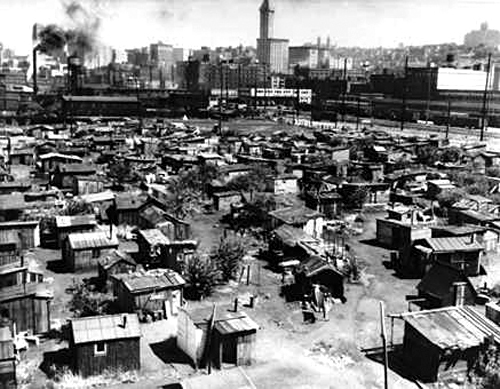
Rather than filtering down, these rudimentary settlements had and have a tendency to "filter up" internally, as residents gained a foothold economically and improved their dwellings.  For most Americans, the best-known of these types of areas are the so-called "Hoovervilles" of the Depression era, when the unemployed and rural migrants occupied low-value or underused land near city centers:

Seattle, WA in the 1930s. Source.
These crude shacks offered little more than shelter from the elements, but they were the result of people in dire situations doing the best they could with what they had available.  Governments then and now refused to accept this reality and, rather than trying to improve the conditions within these settlements, generally favored mass eviction and demolition.  In an interesting twist, this style of development has been rediscovered by contemporary American cities (particularly Seattle), and, without apparent irony, has been rebranded as the "tiny house village."

Beyond housing for the very poorest of the poor, American cities through at least the 1920s built in bulk for the lower end of the income scale.  This housing took several forms:
  • As noted above, shanty housing built by those with little or no experience in construction.
  • Small, temporary and/or transient housing, such as flophouses, boarding houses and other manner of SRO rentals.
  • Small multifamily housing wherein a person of some means would build a home with one or two attached apartments which could be let out at low cost.  Often these apartments would be sub-let to boarders who might occupy a single bedroom.
  • Self-built housing of a higher quality, which might be built from a Sears housing kit, or by a person with some background in construction.  One study estimates as many as 1 in 5 American homes were self-built in the 1920s.
  • As noted in the comments, company towns and other housing built by large businesses for their workers to inhabit. 
The first, second and third of these options were virtually outlawed starting in the 1920s and in the decades following.  What changed during and after the 1920s was not the market's willingness or ability to continue constructing such housing, but society's tolerance for housing of perceived low quality or of profitable use.   The Housing Act of 1937, for instance, was not so much concerned with ensuring affordable housing for the poor, but rather with "the provision of decent, safe and sanitary dwellings for families of low income and the eradication of slums."  Single-room rentals did not fit into this well-meaning but upper middle-class vision.

The "eradication of slums" element of this strategy was more faithfully carried out then the provision of dwellings, and in the process much of the evidence of the low-income neighborhoods of the pre-1950 period was obliterated.  Municipal archives may contain photographic documentation of the condemned neighborhoods, as in the case of Nashville, below, showing a street of tin-roofed shotgun houses and very modest bungalows built in the early 20th century for lower-income tenants.  All were "eradicated" in the 1960s along with much of the surrounding neighborhood and their residents dispersed elsewhere.  That many of these neighborhoods were demolished or saw demand for them fall to near zero, with resultant abandonment, should not cause us to forget they ever existed.

Nashville houses circa 1960; all demolished in urban renewal.  Courtesy MDHA.
It might not be going to far to say that the traumatic process of urban renewal instigated an involuntary filtering, as residents of the poorest areas were literally displaced -- cast out of condemned homes -- and forced to seek new housing from among a diminished housing stock.  These people probably did move into somewhat higher-quality housing, but at higher cost and possibly in more crowded conditions as well.

But what of the fourth type of housing, the proper self-built house?  As it turns out, there was a crackdown on this type of housing as well for reasons that seem to have had less to do with ensuring decent and sanitary housing and more to do with disreputable and exclusionary motives.  The impetus for these changes may have been the mobility provided by the automobile.  I'll quote from one book at length which describes one town's legislative action against black self-builders in Ohio, including one Eddie Strickland:
"In 1946 ... in a series of irregular meetings, the council [of the town of Woodmere, Ohio] passed a building code aimed at restricting do-it-yourself builders, among whom blacks were a prominent group. The code mandated a maximum one-year time limit for the construction of new homes, forbade secession of work for any period longer than forty-eight hours, and prohibited the use of secondhand building materials. Finally, the code required builders to post a $1,000 bond to ensure compliance..... 
"By lifting construction standards (and allegedly enforcing regulations in a discriminatory manner), Woodmere officials raised the cost of home building in the village and substantially limited settlement by working-class blacks. Moreover, the passage of similar building restrictions throughout the county helped limit the number of African American suburbanites in the Cleveland area. The trend had an apparently chilling effect on the attendance of blacks at the weekly land auction in Cleveland, where a number of families had formerly purchased suburban land for delinquent taxes.... 
"Far from being an isolated event, Strickland's confrontation with authorities in Woodmere reflected a national trend toward regulation of the suburban fringe that hastened the decline of working-class suburbanization in the postwar decades. In Cleveland and other metropolitan areas, the proliferation of suburban municipalities led to the extension of land-use regulations to formerly unregulated areas. Zoning and building codes curtailed informal home building and inflated the cost of a suburban home. Racist application of these regulations closed the door on development for blacks, and the enforcement of sanitary regulations led to the demolition of existing black housing and restrictions on domestic production. 
Excerpt from Places of Their Own: African American Suburbanization in the Twentieth Century by Andrew Wiese
Disputes over self-built homes continue to arise today in remoter regions, as seen in the recent lawsuit brought on behalf of Amish homebuilders in upstate New York who were being required by local codes to submit architectural plans and install other expensive features in their self-built farmhouses.  The elimination of the self-built home as an affordable option in much of the country, in conjunction with zoning regulations limiting small multifamily housing, setting minimum lot sizes and imposing other similar restrictions, completed the elimination of the lower rung of prior housing options.  Left were only the newer mobile/prefab home, which partly stepped in to fill the gap that had been left, and the filtering process, which though demonstrably effective was not always rapid enough to insure a sufficient quantity of housing nor sufficiently cheap housing, especially in cities with high residential demand.

Of these two options, mobile homes were heavily restricted in where they could be located, and urban renewal destroyed huge quantities of filtered housing, i.e., "blighted" homes.  The result is a market which appears, artificially, not to create low-income housing options.

Is this article a call for the return of flophouses, then?  Not in the sense of the negative and unsanitary associations of that term and other like it, but in the sense of a government which recognizes that these older types of housing represent the market's effort to meet vital needs, and that regulation can help meet these needs in a safe and sanitary way without taking an adversarial approach toward them.  These market approaches can be complementary to public housing investments and other public assistance programs, as well, rather than being seen as inferior alternatives.  The tiny house village movement mentioned earlier is one such manifestation of this approach, and shows that the political obstacles need not be insurmountable.

Other and related reading:

Friday, November 11, 2011

A Walk Through Occupied NY

Update 11/15: As you've read by now, the settlement shown here was removed last night by the NYPD at the order of the mayor, who was quoted only a week ago stating his lack of objection to the new, higher quality tents that had begun arriving (see end of post).  Since the protestors apparently are barred from setting up new tents, it looks as though this will be the first and last post on this intriguing subject.

With the Washington Post running an article on the "do-it-yourself urbanism" of Occupy D.C.'s encampment, and Steve Stofka observing the emergent patterns evident in Occupy Philadelphia, I decided yesterday to hop on the Lexington Avenue Line down to the Fulton Street stop, just a block or so away from Zuccotti Park, the site of Occupy Wall Street, to see this nearly two-month old settlement up close.  I wasn't alone: a number of foreign tourists, maps and cameras in hand, were also gathered around what has apparently become a major attraction of Lower Manhattan.

Although some earlier photos I'd seen gave the impression of a scattering of tents, tables and ad-hoc meeting places, the park has evolved quickly into a very dense settlement with almost every square foot put to use, a consequence, in part, of the limited space within the granite-walled boundaries of the park, an infill process mimicking the growth of cities within medieval fortifications:


The path at right is the "Main Street" of the settlement, now lined with a mix of the tables of various groups and organizations, from anarchists to pacifists, as well as a large cafeteria, a library, and even some retailers with large, walk-in tents:


The path is generally six feet wide, broadening to eight or so in places.  No one brings in so much as a bike. The "residential" streets, running off this central way, are even narrower, some a couple feet wide, others leaving just enough space to step between the tents:

The police, as far as I could tell, stayed out of the settlement entirely, keeping to the sidewalks around the periphery.  Nor has there been a sign, at least since last month, of any imminent plans for eviction from either the city or the owner of the park (which is by law required to be open to the public round the clock).  The official stance, it is rumored, is to wait for winter cold to disperse the protestors. 

This assumes that the settlement has no capacity to adapt or improve from the current mish-mash of tarps and L.L. Bean summer camping tents  but is this place more analogous to a Soweto or a Rocinha?  I didn't distinctly notice it during my walkthrough, but the photos show the evidence: look closely at the top left of the first photo and you'll notice a pair of large green tents, the first of many scheduled to arrive shortly, and which have been cleared with the city:

"[The OWS members'] newest plan to install 27 military-grade tents designed to stave off freezing temperatures and precipitation, which they began to bring to reality Tuesday, is kosher with the city, Bloomberg said during a Q&A session after an unrelated press conference in Hell's Kitchen Monday."
For a supposedly rudderless movement, "OWS" seems to have set things in rapid motion at Zuccotti Park, although there would be some irony in the settlement coming to outwardly resemble a military barracks.  I'll need to check back in a week or two to see how things have changed, but by the looks of things no one's going anywhere anytime soon.

One last thing: population density.  As best I can tell, for this settlement, it is approximately 150,000 per square mile.

Wednesday, September 7, 2011

Coding Emergence

I've been reading about the work of Swiss programmer and 3D artist Pascal Mueller, who has for the last several years been developing and refining a computer program capable of generating cities of realistic form and complexity.  As the paper introducing the program describes:

"Modeling and visualization of man-made systems such as large cities is a great challenge for computer graphics. Cities are systems of high functional and visual complexity. They reflect the historical, cultural, economic and social changes over time in every aspect in which they are seen. Examining pictures of a large-scale city such as New York reveals a fantastic diversity of street patterns, buildings, forms and textures. The modeling and visualization of large-area cities using computers has become feasible with the large memory, processing and graphics power of today's hardware.

We present a system called CityEngine which is capable of modeling a complete city using a comparatively small set of statistical
and geographical input data and is highly controllable by the user."
The potential applications for a procedural creation range from research and educational purposes such as urban planning and creation of virtual environments to simulation.  Especially the entertainment market such as the movie and game industry have a high demand for the quick creation of complex environments in their applications. ...

The results of one such modeling exercise are shown at right, where a Pompeii lookalike was generated using a few basic inputs -- essentially, a form-based code with architectural guidelines -- derived from study of the archaeological site.

Most interesting to me is CityEngine's process for creating street networks, which Mueller divides into four separate categories: the "basic," or organic, street network, the grid, the radial pattern, and a pattern designed to let streets follow the route of least elevation on hilly terrain (p. 304).  From the point of view of the programmer, the organic network is simultaneously the simplest and the most complex of the patterns:

"This [the "basic"] is the simplest possible rule. There is no superimposed pattern and all roads follow population density. This may also be referred to as the natural growth of a transportation network. Mainly older parts of cities show such patterns. All other rules are based on restrictions of this rule by narrowing the choices of branch angles and road segment length."

The program therefore provides a glimpse at a possible way to mathematically recreate, or at least imitate, the process of organic street growth.  Missing from this initial model is the element of time, and a way to show the evolution of a network, but this is something Mueller has since worked on heavily, as can be seen at this link.  The paper describing the methodology is here.  Remarkably, this appears to be one of the first attempts to realistically model the process of incremental, emergent urban growth by computer simulation (and no, SimCity does not quite count).  To read more, Mueller has most of his articles linked on his website -- this is definitely a work in progress and something to follow.

Monday, August 29, 2011

Ranking "Property Rights"

In a previous post I mentioned the advocacy of economist Hernando de Soto for titling programs in the informal settlements (i.e. slums) of Latin American countries.  De Soto claims that an informal arrangement of land ownership, which is to say an arrangement without the official sanction of a public body, impairs the extraction of capital from land and suppresses property values.  In the 2011 International Property Rights Index, published earlier this year, the Property Rights Alliance attempts to rank property rights protection in over 100 countries using de Soto's particular economic theories as the yardstick.

In addition to "registering property," another of the listed criteria for the ranking is "access to loans," which "is included in the IPRI because access to a bank loan without collateral serves as a proxy for the level of development of financial institutions in a country."  As recently as 2009, however, that year's Index gave a different explanation for the use of this variable: "because accessibility to a bank loan represents the opportunity for an individual to subsequently obtain property. Consequently, the easier it is to become a property owner, the stronger society’s support for a strong formalized property rights system and the investment in property."

At that point, someone may have informed the authors that the rate of homeownership in, say, Mexico, is over 80%, and that only 13% of Mexican homes are encumbered with mortgages.  India, too, has a homeownership rate of over 80%, and it is 79% in Tegucigalpa, Honduras.  Increasing access to loans actually appears to be correlated with a decrease in the rate of property ownership.  How do countries such as Mexico and India achieve this remarkable result? Through two primary means:
  • As the San Diego Union-Tribune notes: "Because Mexico's building regulations are less stringent than those in the United States, it's possible to build small, attached housing units on a massive scale to achieve large economies of scale."
  • Secondly, describing a situation in Honduras common to many Latin American countries: "[A] high rate of owner occupancy can be attributed to the fact that 46% of all residential properties in Tegucigalpa were obtained through illegal land invasion..."
Let's consider these two explanations.  In the first, because Mexico has far lesser restrictions on private property rights -- for instance, a lack of minimum lot sizes, street widths or square feet per unit -- it is possible to construct immense quantities of highly affordable, and decent, housing that people can purchase without even the need for a loan, and still the developers profit.  And yet, in the Index, Mexico is ranked 78th for its protection of property rights, far behind the United States at 18, which in spite of exceptional "access to bank loans" only pushed homeownership, for a fleeting moment, to 69 percent.

Favela street.
Property obtained through "invasion" of private or public land, on the other hand, is the least regulated of all.  Because the state does not formally recognize the occupants' claim to the land, zoning and land use laws are not enforced, and individual property "rights" (defined as an individual's right to use his land for his chosen purposes) are arguably at their fullest, subject only to the possibility of eviction by the state, yet, in the slums of Mexico, the odds that this will happen are  remote (see p. 14). Yet, bizarrely, it is in this freest of all property rights environments that de Soto perceives protection of property rights most lacking. 

Where vacant public or private land is valued highly for residential use, impoverished squatters essentially condemn the large land holdings of indifferent absentee landowners for the benefit of thousands -- the exact inverse of the typical process of urban renewal in the property-rights protecting United States, where in the late 60s and early 70s alone over two million mostly low-income people were evicted from their titled homes to the ultimate benefit of wealthy and influential interests, whether those of well-connected property developers or land-hungry private institutions.

The home-building squatters are in fact living out a Lockean version of property rights, a vision which appeals to natural rather than legal rights:
"Whatsoever then he removes out of the state that nature hath provided, and left it in, he hath mixed his labour with, and joined to it something that is his own, and thereby makes it his property. It being by him removed from the common state nature hath placed it in, it hath by this labour something annexed to it, that excludes the common right of other men: for this labour being the unquestionable property of the labourer, no man but he can have a right to what that is once joined to, at least where there is enough, and as good, left in common for others."  John Locke, Second Treatise of Civil Government.
Interestingly, the Index appears to contain some of the seeds of self-doubt.  A study of an informal settlement in Buenos Aires (p. 58tells a story that is at odds with the dire portrait often painted:


"In La Cava, only 16 percent of those polled said they have a property title for their houses. Some even asked what that was. Among the rest, 17 percent said they have an informal document, usually consisting of an informal sale/purchase invoice. Altogether, 84 percent said they do not have formal documentation. On average, they lived 15 years at the same house, which shows low turnover rates. Those who said they have a property title also have lived at the same house 15 years on average. [Note: longer than the U.S. average of 12 years].
....
There are not many problems in the sale/purchase of housing because deals are made with people they trust and payment is in cash at the moment of possession (90 percent of respondents).  Only 27 percent said there could be installments but much trust or familiar ties were needed.
We asked La Cava dwellers how they solve problems with neighbors when there is conflict related to continued coexistence, such as negative externalities.
....
Confirming conclusions from a subjective cost interpretation of the Coase Theorem, 76 percent said they solve these problems by talking with the other side. They prefer not having intermediaries, either from the same neighborhood or outside, and they avoid violence at all cost."
This case study calls into question two of de Soto's major assumptions: that informal owners face insecurity of tenure, when they in fact have longer tenure than American homeowners; and that without titles, sales will be difficult to make, when they seem to be easier, quicker and cheaper to make, being bought and sold like any other good.  This informal model of development is not necessarily one to emulate, but one to learn from, and particularly a good way to sharpen thinking as to what exactly is meant when we're talking about "property rights," and what sort of criteria might be best used to rank countries along those lines, if looking beyond the ones used in the Index.

Sources and Additional Reading:
2011 International Property Rights Index
Mexico's House Rules
Homeownership Rates: A Global Perspective

Urban Land Tenure Options: Titles or Rights?
Regularization of Informal Settlements in Latin America
Secure Tenure in Latin America and the Caribbean
The Role of Urban Slum Titling in Slum Improvement

Tuesday, July 5, 2011

Slums, Titles and the World's Simplest Zoning Code

Although from the perspective of a resident of the United States, Canada, Western Europe or a handful of other countries, the organic pattern of city growth might seem to be a historical bygone, visible only in those portions of cities developed before the late 17th century, the last 50 years have in fact produced the greatest wave of emergent urbanism in human history.  This growth, reflected in the so-called slums of South and Central America, Africa and Asia, utterly dwarfs in scale any formally-planned public housing built during that time, and currently houses between 1 and 1.4 billion people worldwide.

"Slum" (Rio De Janeiro) and below ...
These settlements, built with virtually no guidance or oversight, produce urban environments of extraordinary complexity, beside which even the most carefully designed project can seem simplistic by comparison.  Although they are not always beautiful in a conventional sense, their astonishing variety makes them a favorite of photographers with an artist's eye and appreciation for the visual interest of a basic built form repeated in endless irregular variations across a dramatic landscape, much like the Italian Cinqueterre or the towns of the Aegean islands. 
... international tourist destination (Riomaggiore).

A New York times article, writing about the Mumbai slum that was the setting for the film "Slumdog Millionaire," describes how the visual complexity of these places is matched by their economic complexity and the resourcefulness of their inhabitants -- an inventiveness that recalls Jane Jacobs' observations in The Economy of Cities:
"Understanding such a place solely by the generic term “slum” ignores its complexity and dynamism. Dharavi’s messy appearance is nothing but an expression of intense social and economic processes at work. Most homes double as work spaces: when morning comes, mattresses are folded, and tens of thousands of units form a decentralized production network rivaling the most ruthless of Chinese sweatshops in efficiency. Mixed-use habitats have often shaped urban histories. Look at large parts of Tokyo. Its low-rise, high-density mixed-use cityscape and intricate street network have emerged through a similar Dharaviesque logic. The only difference is that people’s involvement in local development in Tokyo was seen as legitimate."
The traditional response to such settlements by city and national governments, still common today, is to evict the inhabitants and demolish the structures. Uprooting the community in this fashion destroyed the energy and scarce resources that the residents had put into their dwellings, disrupted social and economic networks, while the construction of new public housing, intended to host at least some of the displaced residents, redirected government revenue that might have been used to improve the existing settlement to building an inadequate number of units which were poorly suited for people's social and economic needs

More recently, in acknowledgment of the counterproductiveness of demolition, various South American governments, notably Mexico and Peru, have begun issuing formal titles to the possessors of slum properties.  The stated purpose of this approach, advocated by economist Hernando de Soto and endorsed by none other than Milton Friedman, is to increase tenure security and to permit the land to be used as security for business loans. 

So far, although titling of properties has led to an average 25 percent increase in land values, the promised access to capital has largely failed to materialize.  Further, the awarding of formal titles has often served as an invitation to outside real estate interests to enter the market, futher inflating prices and potentially driving out the very people whose tenure the titling program was purportedly designed to protect.  In Mumbai, this process took the form of large apartment towers sprouting in the low-rise Dharavi slum, adding height without necessarily increasing density (in any event population density in these areas appears to be exceptionally high even in the absence of buildings over three stories).

An alternative approach, adopted mainly in the Brazilian city of Recife, has been to provide tenure security not with titles, but by recognition of the community's claim to the land, combined with the implementation of what is perhaps the simplest zoning code to be found anywhere in the world: 1) a two-story height limit; and 2) a maximum lot size of 150 square meters (1,615 square feet).  Informal exchanges of property, without deed recording or title transfer, continue unhindered, reducing transaction costs and encouraging an extremely flexible urbanism where boundaries and structures rapidly adapt to changing needs. 

Mathieu Helie argues that the remarkable organic form of these slums is dependent on this openness -- an attempt to make them conform to a particular notion of property rights (that of individual freehold ownership by way of titles, deed recording and plat maps) is to deprive it of the flexibility that allowed it to take shape in the first place:
"After praising slums for their ability to generate economic opportunities, they are denounced [by a City Journal article] for not fitting into the conventional model of property rights. Yet it is precisely the use of more natural methods of property allocation that gives slums their organic morphology. ...

"Just like we can’t make the organic morphology of slums fit into the modern rules of property ownership, we can’t make traditionally emergent cities through the current planning system. (All efforts to produce traditional neighborhoods have so far produced only imitations of them.) ..."
The question of how to produce such traditional or emergent environments in a developed country in the present day is one which people such as Christopher Alexander have devoted their careers to, but answers, in practice, remain elusive.  The example of places like Recife does suggest the answer could be simpler than ever imagined.

Sources and Additional Reading:
Urban Land Tenure Options: Titles or Rights?
Regularization of Informal Settlements in Latin America
Secure Tenure in Latin America and the Caribbean
The Role of Urban Slum Titling in Slum Improvement

Wednesday, June 22, 2011

The New York That Wasn't (But Might Have Been), part II

Before showing an illustration of a Manhattan as it might have grown in the absence of a single central plan, it's worth considering for a moment how it was that the plan that the Commissioners drew up actually came to be, in spite of the extensive network of roads that already covered Manhattan in 1807.  Answers are difficult to come by, as the Commissioners' very brief account of their decision-making process raises nearly as many questions as it answers.

The Commissioners did, however, claim that they had attempted to follow existing streets and property lines:

"Having determined, therefore, that the work in general should be rectangular, a second, and, in their opinion, an important consideration was so to amalgamate it with the plans already adopted by individuals as not to make any important changes in their dispositions.  ... This, if it could have been effected consistently with the public interest, was desirable, not only as it might render the work more generally acceptable, but also as it might be the means of avoiding expense. It was therefore a favorite object with the Commissioners, and pursued until after various unsuccessful attempts had proved the extreme difficulty, nor was it abandoned at last but from necessity. To show the obstacles which frustrated every effort can be of no use. It will perhaps be more satisfactory to each person who may feel aggrieved to ask himself whether his sensations would not have been still more unpleasant had his favorite plans been sacrificed to preserve those of a more fortunate neighbor."


1782 British Headquarters map with existing streets
and roads highlighted
Leaving aside the absence of any explanation on this fundamental point, and the debatable conclusion that it is preferable to frustrate everyone's interests than to frustrate only some, another point worth noting is that the Commissioners attempted to accommodate existing interests to the plan only after "having determined ... that the work ... should be rectangular."  Since the existing roads of Manhattan largely followed an organic pattern, as can be seen at right, any attempt to conform them to an inflexible rectilinear grid was doomed to failure from the start – a fact which would have been immediately obvious to an experienced surveyor such as Commissioner Simeon De Witt.

This order of consideration could only be justified if the Commissioners believed that the public advantages of the grid plan outweighed any public benefits to be gained from following existing streets and property lines.  Such a comparison of costs and benefits is not made in the Commissioners' report, however.  Instead, the Commissioners compare the unadorned grid to a caricature of Baroque city planning ("those supposed improvements by circles, ovals, and stars which certainly embellish a plan") an oversimplistic and unserious exercise which seems designed to set up the choice of the grid without having to explain its supposed benefits. 
The same map with farmland boundaries
drawn in as new streets and roads

In fact, only one benefit of the grid is ever stated in the report: that "a city is to be composed principally of the habitations of men, and that straight-sided and right-angled houses are the most cheap to build and the most convenient to live in."  Even assuming for the moment that this statement is true, it is irrelevant, since virtually all cities, from L'Enfant's Washington D.C. to the medieval city centers of Europe are composed overwhelmingly of straight-sided and right-angled houses -- including 17th century New York itself, where every house appears to be straight-sided and right-angled, just as most of the houses of old Amsterdam were

By contrast there are two clear advantages of following the existing roads within the Commissioners' own report: 1) it had more public support and 2) it was less expensive -- not surprising, since the roads were already present, and did not need to be surveyed, marked or excavated.  Had the existing farmland boundaries formed new streets and lanes leading from the existing roads, in a typical pattern of incremental organic growth, the pattern would have grown still more complete, as shown at left.

So what was actually underlying the Commissioners' decisionmaking?  Peter Marcuse in his 1987 essay concludes that "the grid in 1811 in New York signalled the triumph of the interests of larger landowners and speculators over all competing concerns," indirectly suggesting that the Commissioners' stated concern for the public good was an empty gesture.  In this view, the "convenience" of the plan mentioned in the report reflected only that the grid was easy to survey and created lots that were easy to track and sell.  Perhaps the Commissioners, having been entrusted to "plan" the city, also could not imagine a form of "planning" that did not involve drawing straight lines and right angles.  Whatever the reason (and ease of surveying can't be ruled out), this planning idea caught on, and as Marcuse observes the remainder of the century saw thousands of American towns and cities laid on on regular grids.  

Still, with use of the 1782 map shown here, it is possible to consider what might have happened if the Commission's task had been limited by the New York legislature to only surveying the roads in existence, and marking out new lanes along existing paths and boundaries -- or if no Commission had come into existence at all (while further taking the license of omitting some of the speculative grids which were laid out between 1782 and 1811).  With many additional streets filled in according to topography and property lines, I'll leave you with one version of how that lower Manhattan might have eventually looked:

Thursday, June 16, 2011

The New York That Wasn't (But Might Have Been), part I

The Commissioners' plan.
An attempt at a more reflective piece today as a short break from garages and alleys. (Updated 6.18.11 with Urbanphoto link).

March 2011 marked the bicentennial of the Commissioners' Plan of New York, the document which laid out Manhattan's familiar street grid from the vicinity of Houston Street north to Harlem.  In recognition of this milestone, there's been a modest amount of reflection on the plan both in the press and in the blogosphere, with some praising the plan, and others thoughtfully ambivalent.

In the past, however, the critical voices have generally been the loudest. Peter Marcuse in a 1987 essay referred to it as "one of the worst city plans of any major city of the developed world;" Frederick Law Olmsted criticized it for its "rigid uniformity;" John Reps noted its scarcity of sites for public buildings, lack of enough north-south streets, and frequent intersections creating traffic congestion; others have faulted it for obliterating Manhattan's natural landscape, while Recivilization has perhaps the most memorable turn of phrase, calling the Commissioners' plan "breathtaking in its monotony."

In spite of all these critiques, there's been relatively little thought devoted to what an alternative to the grid might have looked like.  To the extent that they are discussed at all, alternatives generally take the shape of the Baroque plans of the late 18th century in the manner of L'Enfant's plan for Washington D.C., with diagonal boulevards and grand circles, as one Columbia design class recently imagined.*  More realistically, Urbanphoto has an outstanding post on an earlier plan drawn up by city surveyors John Mangin and Casimir Goerck which was somewhat more more accommodating of the street networks already emerging north of the city.

*(The Commissioners had, in fact, considered such features and rejected them for ostensibly utilitarian reasons, although little more than a century later the planning departments of checkerboard cities such as Portland would note a lack of diagonal routes as a major utilitarian shortcoming of the grid).

There is another possibility, however, one that requires acknowledgment that the Commissioners' plan did not cover virgin ground, but rather overlaid and blotted out a complex network of roads, streets and paths that already covered Manhattan as early as the 1770s.  In the British Headquarters map of 1782, featured prominently in Eric Sanderson's recent book Mannahatta, not only is the former Indian trail of Broadway clearly discernible running the length of the island, but dozens or hundreds of other roads also, large and small, serving the many farmhouses and budding villages north of the city limits.  These roads were not planned by a single mind, but worn into the terrain by countless feet following a subtler intelligence: the intuitive search for the smoothest, most level and most direct paths to the most important destinations, perfected by repetition over years, decades and centuries. 

Oddly, it is this process of road and street formation -- which Spiro Kostof refers to as the organic typology -- which earns the least respect from writers on urbanism.  On New York's organic street network in lower Manhattan, dating to the days of the Dutch settlers, it's easy to find statements like these:

"Until the grid most New Yorkers were clustered below Houston Street in a confused maze of streets and lanes."

"Prior to the Commissioner’s grid plan, the city’s streets had been laid out rather willy-nilly, as befitting a city that was founded in essentially late mediaeval times..."

There seems to be an assumption that if a street network does not have obvious regularity or other indisputable evidence of direct human design, then it must be simply random and therefore, impliedly, inefficient or unsuited to the needs of the people living along it.  But was this street network really "confused" or "willy-nilly"?  Here is an adaptation of the Castello Map of New York, dating from 1660 and showing the streets and homes of the city at that time:


The Dutch origins of the city, with its canals, are obvious, but the functional logic of the streets, though evidently not formally planned, are anything but confused or irrational.  Broad streets carry commerce to and from the waterfront and gently angle northwards, reflecting the natural course of trade unencumbered by sharp right-angled turns.  Single-family homes are being built along the quieter narrow lanes running perpendicular to the thoroughfares, with the process of block subdivision reflecting the higher value of land close to the docks. 

There is an elegant mathematical order to the street network as well: each curve of the broad streets defines a shape which mimics the shape of the island itself.  This is a typically fractal pattern, defined as "a rough or fragmented geometric shape that can be split into parts, each of which is (at least approximately) a reduced-size copy of the whole."  (See Mathieu Helie's extensive writings about this idea in the context of architecture and urbanism.)  This particular pattern is presumably the result of accommodating a grid-like network of streets, with blocks of roughly equal size, to the constrained geography of Manhattan. 

In the following century, this initial plan was organically extended north of the wall, guided by pre-existing paths and roads.  In the following post I'll show a rendering of what might have resulted had the city of the 1790s simply decided to let this process, ongoing at that point for almost 175 years, continue to follow its natural course.

Saturday, March 19, 2011

A Critique of the Grid, part II

Miletus' "Hippodamian" Plan
I've been reading a bit about Hippodamus of Miletus, the man credited with popularizing (if not inventing) the grid in the Western urban tradition.  I'd always considered the grid a reflection of a rational Classical Greek mindset, but Hippodamus seems to have been as much concerned with engineering utopian outcomes as simply laying out a physical plan — making himself out to be the Ebenezer Howard or Frank Lloyd Wright of his day. 

None other than Aristotle had rather uncomplimentary things to say about him and his ideas, calling him "a strange man, whose fondness for distinction led him into a general eccentricity of life," (Politics, Book II part VIII), and regarding Hippodamus' apparent plan for a third of city-dwellers to practice agriculture, reasonably asking "what use are farmers to cities?"

Aristotle did, however, tentatively endorse the so-called "Hippodamean" grid, writing that "[t]he arrangement of private houses is considered to be more agreeable and generally more convenient, if the streets are regularly laid out after the modern fashion which Hippodamus introduced."  Politics, Book VI, part XI.  Left unasked was the question of whether there was a relationship between Hippodamus' social proposals, which Aristotle denigrated, and his choice of the checkerboard grid.  Although some have credited the grid as an egalitarian choice for city planning, Hippodamus' evident plan for a top-down, class-stratified society run by a military caste (in a city designed by none other than himself) hardly reflects a democratic preference.  

In fact, rather than being an embodiment of egalitarianism, the grid's emergence is most closely associated with the rise of powerful and centralized states (see The Dark Side of the Grid), although other motives may factor in as well.  China's imperial capitals, for example, employed a grid not for convenience of wayfinding but as an imperatorial aesthetic of sorts intended to reinforce the order and centralized authority of the emperor.  In the Renaissance, the grid embodied an rarefied aesthetic of uniformity and rationality.  For others, such as the expansionist Greeks of the 6th century B.C. and 19th century Americans, the grid was an enabler of land speculation in newly-settled territory. 

The one purpose the grid has never served, evidently, is the desires and everyday needs of the citizens actually living in the city.  Where the centralizing power responsible for maintaining the grid disappears, the grid therefore frequently breaks down.  As Spiro Kostof writes in The City Shaped on the fate of gridded Roman cities in the medieval period:

"The grid is inflexible in terms of human movement.  We are not inclined to make right-angle turns as we go about from place to place unless we are forced to do so.  With the impairment of municipal controls in in the post-Roman city, natural movement soon carved shortcuts through the large rigid blocks of the grid." (p. 48).

This process is apparent in the ancient town of Rimini, at left, where the current street network, in black, is shown overlaying former Roman grid.  The grid's failure to provide direct routes to the central market (other than the Roman Cardo and Decumanus) has been partially addressed by diagonal pass-through alleys; overly large blocks have been bisected; sharp turns have been smoothed in an emerging concentric pattern, and (not visible in the diagram) many streets were narrowed from their Roman proportions.

The New Urbanists seem to have retreated from their initial praise for the "hypertropic" 19th century American grid and today advocate more complex street patterns with a hierarchy of streets.  The lessons of the grid, though, in a broad historical context, may not yet have been fully appreciated.

Wednesday, March 2, 2011

"Anarchic Urbanism" Update

When valuable city land is left open and vacant by an absentee owner, enterprising individuals may enter and create functional living spaces, start-up businesses and entire self-governing communities on their own initiative.  This process of emergent organization, derided as anarchic by detractors (see video), in fact is anything but.

In Caracas, an unfinished 45-story tower, planned for office use but now under nominal state ownership, has been occupied by squatters.  Undeterred by the initial lack of plumbing and electric, not to mention lack of elevators, they have settled the building up to the 28th floor (apparently refuting the theory that people will refuse to walk up more than four to six storeys to an apartment), and, in the absence of zoning constraints and building codes, have added infrastructure and developed a mix of uses within the building:
"[S]quatters ... have created a semblance of order within the skyscraper they now call their own. Sentries with walkie-talkies guard entrances. Each inhabited floor has electricity, jury-rigged to the grid, and water is transported up from the ground floor. ... A beauty salon operates on one floor.  On another, an unlicensed dentist applies the brightly colored braces that are the rage in Caracas street fashion. Almost every floor has a small bodega."
Although the Times article chalks up the situation in part to the economic mismanagement of the Chavez government, such  squatter communities are not unknown in the West.  In the news recently was the Copenhagen neighborhood of Christiania, a former army barracks which was settled by various counterculture elements in the early 1970s following its abandonment by the military. 

In the absence of any intervention by the municipal government, and ungoverned by city codes, the settlers created not anarchy but (surely unintentionally) what has become the second most popular tourist attraction in Copenhagen.  While this is often attributed to the drug vending in the neighborhood, the remarkable architecture and emergent urbanism of the area are clearly major draws as well.  

And although it's not recent news, no mention of anarchic urbanism would be complete without a reference to the now-vanished Walled City of Kowloon, another extraordinary emergent transformation of a former military barracks.

(h/t Infrastructurist for Times article.)

Wednesday, January 12, 2011

Aldea de Rey and a Critique of the Grid

The arrival of Google's comprehensive satellite view some years ago, and more recently Street View, has been a huge benefit for anyone with even a passing interest in urbanism.  To take advantage of these amazing mapping tools, from time to time I'll use them to explore a city or town typically one with emergent characteristics in overall plan  partly for fun, and partly to see what can be learned.

This week's location is the southern Spanish town of Aldea de Rey (literally "King's Town"), a village chosen not for its distinctiveness but for being representative of small towns of the region (and for being small enough to be shown in detail on this blog). 

The town has a characteristically medieval spindle-shaped plan (p. 139) in a north-south orientation, indicating that at the time it was founded, as today, the primary flow of traffic was between the city of Ciudad Real to the north and smaller destinations to the south:

The central square is easy to pick out.  The road network surrounding it appears to have grown gradually over time: an initial "spindle," clearly discernible in the top half of the photo, encompasses most of the town square; to that initial shape is appended an addition angling to the southwest, which doubles or triples the size of the town while retaining the overall spindle shape.  Finally, a series of straighter roads, mostly to the east, further expand the settled area.

Although the road network may appear chaotic and inefficient on first glance, using Google's directions tool on the "walking" function reveals something interesting.  Using the New Urbanist metric of the five-minute walk, here is pictured the distance one can cover along various routes in five minutes, starting from the square (marked with a star):
Apparently the central point of the town is accessible to nearly every resident by only a quick stroll.  Even the newer streets bend around the gravitational pull of the center, keeping most residences within the five-minute walking radius. 

Although New Urbanist thought tends to emphasize the grid as a walkable alternative to the modern suburban pattern of arterial roads and cul de sacs, walkability is of course not an end in itself but rather a means to an end (arriving at one's destination, among other benefits).   A formal grid of relatively low-density residential structures, however, as is pictured in the previous link, offers few non-residential destinations and no obvious focal point.  Where centers of commerce, entertainment, etc. do exist, the grid may inhibit walking by failing to offer diagonal "shortcuts" and forcing the walker to follow a lengthier zig-zag path. 

The cul-de-sac approach, for all its failings, does at least acknowledge a hierarchy of streets and therefore features locations which are more central than others.  The town of Aldea de Rey offers one example of a layout that combines the connectedness of the grid with a centered focus that will attract the pedestrian volume sufficient to support retail and other businesses.