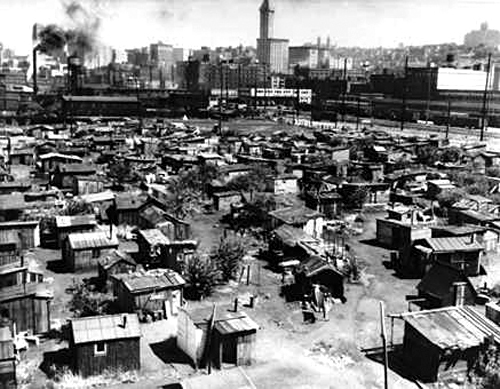
Although this may be somewhat accurate so far as it only applies to formal housing developers, throughout the history of American cities and indeed most other cities in the world, a large portion of the housing stock came from the informal economy, most of it purpose-built for indigent migrants or very poor laborers. This was the case even in some of the largest and wealthiest cities in the Western world until fairly recently.
In the typical city, such housing would (and is) either be found on the outskirts or on very low-value urban sites, such as floodplains, rocky ground or steep slopes. Infrastructure was poor and public services were minimal or nonexistent.
 |
| American Favela: The "Dutch Hill" area of midtown Manhattan in 1863. Source here. |
 |
| Seattle, WA in the 1930s. Source. |
Beyond housing for the very poorest of the poor, American cities through at least the 1920s built in bulk for the lower end of the income scale. This housing took several forms:
- As noted above, shanty housing built by those with little or no experience in construction.
- Small, temporary and/or transient housing, such as flophouses, boarding houses and other manner of SRO rentals.
- Small multifamily housing wherein a person of some means would build a home with one or two attached apartments which could be let out at low cost. Often these apartments would be sub-let to boarders who might occupy a single bedroom.
- Self-built housing of a higher quality, which might be built from a Sears housing kit, or by a person with some background in construction. One study estimates as many as 1 in 5 American homes were self-built in the 1920s.
- As noted in the comments, company towns and other housing built by large businesses for their workers to inhabit.
The "eradication of slums" element of this strategy was more faithfully carried out then the provision of dwellings, and in the process much of the evidence of the low-income neighborhoods of the pre-1950 period was obliterated. Municipal archives may contain photographic documentation of the condemned neighborhoods, as in the case of Nashville, below, showing a street of tin-roofed shotgun houses and very modest bungalows built in the early 20th century for lower-income tenants. All were "eradicated" in the 1960s along with much of the surrounding neighborhood and their residents dispersed elsewhere. That many of these neighborhoods were demolished or saw demand for them fall to near zero, with resultant abandonment, should not cause us to forget they ever existed.
 |
| Nashville houses circa 1960; all demolished in urban renewal. Courtesy MDHA. |
But what of the fourth type of housing, the proper self-built house? As it turns out, there was a crackdown on this type of housing as well for reasons that seem to have had less to do with ensuring decent and sanitary housing and more to do with disreputable and exclusionary motives. The impetus for these changes may have been the mobility provided by the automobile. I'll quote from one book at length which describes one town's legislative action against black self-builders in Ohio, including one Eddie Strickland:
"In 1946 ... in a series of irregular meetings, the council [of the town of Woodmere, Ohio] passed a building code aimed at restricting do-it-yourself builders, among whom blacks were a prominent group. The code mandated a maximum one-year time limit for the construction of new homes, forbade secession of work for any period longer than forty-eight hours, and prohibited the use of secondhand building materials. Finally, the code required builders to post a $1,000 bond to ensure compliance.....
"By lifting construction standards (and allegedly enforcing regulations in a discriminatory manner), Woodmere officials raised the cost of home building in the village and substantially limited settlement by working-class blacks. Moreover, the passage of similar building restrictions throughout the county helped limit the number of African American suburbanites in the Cleveland area. The trend had an apparently chilling effect on the attendance of blacks at the weekly land auction in Cleveland, where a number of families had formerly purchased suburban land for delinquent taxes....
"Far from being an isolated event, Strickland's confrontation with authorities in Woodmere reflected a national trend toward regulation of the suburban fringe that hastened the decline of working-class suburbanization in the postwar decades. In Cleveland and other metropolitan areas, the proliferation of suburban municipalities led to the extension of land-use regulations to formerly unregulated areas. Zoning and building codes curtailed informal home building and inflated the cost of a suburban home. Racist application of these regulations closed the door on development for blacks, and the enforcement of sanitary regulations led to the demolition of existing black housing and restrictions on domestic production.
Excerpt from Places of Their Own: African American Suburbanization in the Twentieth Century by Andrew WieseDisputes over self-built homes continue to arise today in remoter regions, as seen in the recent lawsuit brought on behalf of Amish homebuilders in upstate New York who were being required by local codes to submit architectural plans and install other expensive features in their self-built farmhouses. The elimination of the self-built home as an affordable option in much of the country, in conjunction with zoning regulations limiting small multifamily housing, setting minimum lot sizes and imposing other similar restrictions, completed the elimination of the lower rung of prior housing options. Left were only the newer mobile/prefab home, which partly stepped in to fill the gap that had been left, and the filtering process, which though demonstrably effective was not always rapid enough to insure a sufficient quantity of housing nor sufficiently cheap housing, especially in cities with high residential demand.
Of these two options, mobile homes were heavily restricted in where they could be located, and urban renewal destroyed huge quantities of filtered housing, i.e., "blighted" homes. The result is a market which appears, artificially, not to create low-income housing options.
Is this article a call for the return of flophouses, then? Not in the sense of the negative and unsanitary associations of that term and other like it, but in the sense of a government which recognizes that these older types of housing represent the market's effort to meet vital needs, and that regulation can help meet these needs in a safe and sanitary way without taking an adversarial approach toward them. These market approaches can be complementary to public housing investments and other public assistance programs, as well, rather than being seen as inferior alternatives. The tiny house village movement mentioned earlier is one such manifestation of this approach, and shows that the political obstacles need not be insurmountable.
Other and related reading: