Showing posts with label Malls. Show all posts

Saturday, February 20, 2016

Rehabilitating Walmart

Walmart has been in the news more than usual of late, with the announcement that it was closing 269 of its stores as well as backing out of building two stores in lower-income areas of Washington, D.C. Add this to Walmart's stock price decline of nearly 30% during 2015, and the picture begins to look somewhat bleak.  Although Walmart's financial prospects for the future are an interesting topic, it's the chain's position within urban environments that has been relatively little explored.

To set the context, it's crucial to note that Walmart has become in essence a bloated grocery chain, with 56% of its sales coming from groceries.  The growth in the grocery sector has been achieved in spite of the fact that Walmart earns by far the lowest customer satisfaction rating for its supermarket offerings of any major chain.  Moreover, the grocery business is more localized then the variety store
business. According to one recent study on the market effect of Walmart on the supermarket business:
"We find that Wal-Mart’s impact is highly localized, affecting firms only within a tight, two-mile radius of its location. Within this radius, the bulk of the impact falls on declining firms and mostly on the intensive margin. Entry of new firms is essentially unaffected. Moreover, the stores most damaged by Wal-Mart’s entry are the outlets of larger chains. This suggests that Wal-Mart’s expansion into groceries is quite distinct from its earlier experience in the discount industry, where the primary casualties were small chains and sole proprietorships that were forced to exit the market." 
It seems that, for grocery purchases, most consumers are unwilling to undertake longer journeys than necessary even for somewhat lower prices.  Walmart's use of the "Supercenter" business model, however, means that it is impossible extend those two-mile radii over an entire metro area.  Moreover, the dependency on low land prices for these stores means that Walmart is often absent from entire central areas of cities.

In San Antonio, for example, there is not a single Walmart establishment in the central 50 square miles of the city.  By contrast, local chains like H-E-B and independent groceries have the flexibility to open stores within central areas.  The abandonment of Walmart's "Express" stores with the recent closings seems to have spelled an end for an attempt to compete with these smaller urban groceries.
Further, these supermarket chains have been edging in on Walmart's own territory, with chains like Kroger beginning to stock clothing and a wider range of household items in their most recently opened stores.  The competition from Amazon has been widely reported on as well.

------------------------------

From an urbanist perspective, it's easy to cheer all this news and condemn these stores as destroyers of local business and magnets for the car-dependent, but does it need to be this way?  I'm not so sure.  The person who can find no redeeming qualities in big-box stores ignores a central fact of the modern US retailing industry, and to his or her peril.  If the conclusion is that these stores are incompatible with urbanism, then a large portion of the retail business will be relegated to the car-dominated realm.

Could we instead imagine, rather than a mall anchored by a big box store, a community supported by one of these same stores?  There is no need to imagine, as such spaces already exist.  In a suburb of Madrid, for example, here is a Carrefour hypermarket (the local equivalent of a Walmart or Target, at center) surrounded by a residential development and with no surface parking:


Although there is some underground parking, there is no surplus, and hundreds or thousands of surrounding residential units are within walking distance of the market.  Rather than detracting from small business, the pull of the market draws traffic down arteries past other businesses, providing them with needed foot traffic.  It should be noted there is rapid transit in close proximity as well, just barely visible in the lower left hand corner, and there is also a network of segregated bicycle paths.

There are historic precedents for this sort of urbanism in the form of the souk or bazaar, itself a sort of mall at the center of a walkable city, as well as the ancient Roman forum, which was often little more than temple in the middle of a two-story arcaded and enclosed shopping mall.  Some structures, such as Trajan's market in Rome, were in fact enclosed malls of shops and offices with an appearance very similar to those of today.

Trajan's Market in Rome, one of the first "dead malls." Via Flickr.
 In a sense, the big box store offers unusual possibilities for walkability, and yet these have rarely if ever been taken advantage of within the United States.  Although there are some urban big box stores, the number of consciously planned "Walmart-oriented developments" appears to be close to zero (but wait -- see below).  Although there are many master-planned developments which incorporate retail, none are anywhere near as integrated as the above Spanish example.

A Target and supporting retail in Phoenix, AZ.
The typical Walmart or Target is designed around the assumption that near 100% of customers want to arrive and will arrive by driving, but this is also a self-limiting business model that virtually eliminates quick or impulse shopping trips, or trips by those without access to a car.  It is easy to envision how a combination of higher quality and more local food shopping options plus online shopping could threaten to weaken these chains' business model.

A greenfield Walmart or Target truly integrated with its surroundings and embracing the possibilities of pedestrian access -- even if it required these companies to dabble in residential real estate -- could have tremendous upside.  Using a five-minute walkshed, a sufficient density could be obtained using some of the residential forms visible in the Phoenix image above to provide the store with a reasonable portion of the customer base needed to economically sustain it.  Moreover, it would just be a more pleasant environment in which to live.

The challenge of incorporating parking, which would still be needed in lesser amount, was resolved in the Madrid example by a partially underground lot.  An alternative, rarely explored, is to place parking on the roof of a building.  The added construction expense might be compensated for by surrounding residential land use.

Rooftop parking at a Whole Foods in Washington, D.C.
This just in: just before I planned to publish this piece, Washington Business Journal published renderings of a newly-planned development in Washington DC that incorporates almost all the principles I discussed above:


Note the parking on the roof and the use of what would have been the surface parking area for shops and residential on narrow streets (!) closely integrated with and with easy walking access to the "big box" store at lower right in the rendering.  I have to think that this is the way forward for the big box store.  This design format makes allowance for car trips but embraces walkability as well.  It will be interesting to see how this project fares and if the concept catches on in other cities.

Friday, December 25, 2015

That 70s Urbanism, Part II: Fixing Urban Renewal

On Twitter, Cap'n Transit appreciated my focus on Stamford in the previous post, so to continue on the prior topic with an ongoing focus on the 1970s, I'll return to that city to offer some perspective on the past as well as some ideas for the future.

Best known as an office escape for New York-based banks and other companies, the city actually has a history nearly as old as New York itself and, before urban renewal, had a street pattern as intricate as lower Manhattan's old Dutch footways.  The New York and New Haven railroad cleaved the town in the late 1840s, and in the part south of the tracks polluting factories cropped up along the waterfront and canal.  In the 1950s, Interstate 95 ripped another path through the heart of the city, though partly following the railroad right-of-way.

Stamford's downtown in the midst of renewal, 1979. City of Stamford via Ferguson Library.
Finally, a massive urban renewal project, initiated in the 1950s but only carried out in full in the 1970s, destroyed the bulk of the city's downtown area and resulted in the demapping of many streets, even including the primary stretch of Stamford's Main Street.  These streets were replaced by high-speed "stroads," and the office buildings that replaced the fine-grained fabric of the city took the form of glass and granite monoliths perched over parking lots, serving as fortresses against the miasma presumably thought to be swirling on the near-empty sidewalks.  A large enclosed three-anchor mall was constructed over several blocks of condemned buildings.

Reworking 1970s Urban Renewal

The age of massive urban renewal on the scale that Stamford pursued is over, by and large, some planning projects in Baltimore excepted.  Stamford is unlikely to ever engage in another project of such scope.  As I noted in the previous post, however, a city like Stamford can still use those elements of 1960s and 1970s planning to its advantage if it plays its cards correctly.

The 1970s as I wrote were an early golden age of pedestrian infrastructure as reflected by several key elements which are broadly applicable to today's cause of walkability, although not all are today well-regarded:
  • Mass transit (obviously - the 70s witnessing a revival of heavy rail systems)
  • Generous use of elevators in public space
  • Escalators and moving walkways
  • Pedestrian tunnels, skyways and covered sidewalks
  • Pedestrianized streets
  • Enclosed malls and other shopping areas
In addition to the above, Stamford has in the last 20 years enjoyed a resurgence of the "Euro block" apartment form throughout the downtown area, in addition to an earlier boom in townhouse-over-garage condominium construction.  Although Stamford will not be Barcelona anytime soon, good things can be and should be happening, but the downtown is as car-dominated as ever.  How about a plan for incremental improvement?

The plan I put forward has several components, some inspired by Jane Jacobs, some by Jeff Speck, some by Nathan Lewis and Japanese city planning, and by others too numerous to mention:
  1. Extend the enclosed shopping area in the train station
  2. Narrow several of the downtown streets by sidewalk widening and use of bike lanes
  3. Use eminent domain and existing public land to open several new narrow streets
  4. Provide arcaded pedestrian streets where appropriate
  5. Open the mall to the street and re-open Main Street
  6. Use the under-capacity mall and Target parking lots for long-term parking for downtown residents in lieu of parking requirements
In most cases, new streets are built on existing public land and would require little or no condemnation.  Some simply represent streets which were uprooted and de-mapped during urban renewal.  Most vital to these is the continuation of narrow Summer Street down to the UBS building.  The street narrows to only about 16 feet at its southern extremity, and should be continued at that width further south, ideally as a shared space or even pedestrianized shopping street that will provide a safe and attractive walking path from the train station (a moving walkway probably veers too far into parody/Seinfeld territory).  As a 16' street, it could possibly be arcaded as well.  The street would terminate at the UBS building into an existing pedestrian pathway that leads to the train station.

This image, rotated counterclockwise, shows how the new street would appear lined by Euro block apartments and shops, leading with only a couple of curved turns directly to the train station, which has an existing underpass lined with a few shops passing underneath I-95.  This line of shops would be carried across past I-95 and along the path in front of the UBS building, possibly incorporating an anchor store:


Patching Up the Mall

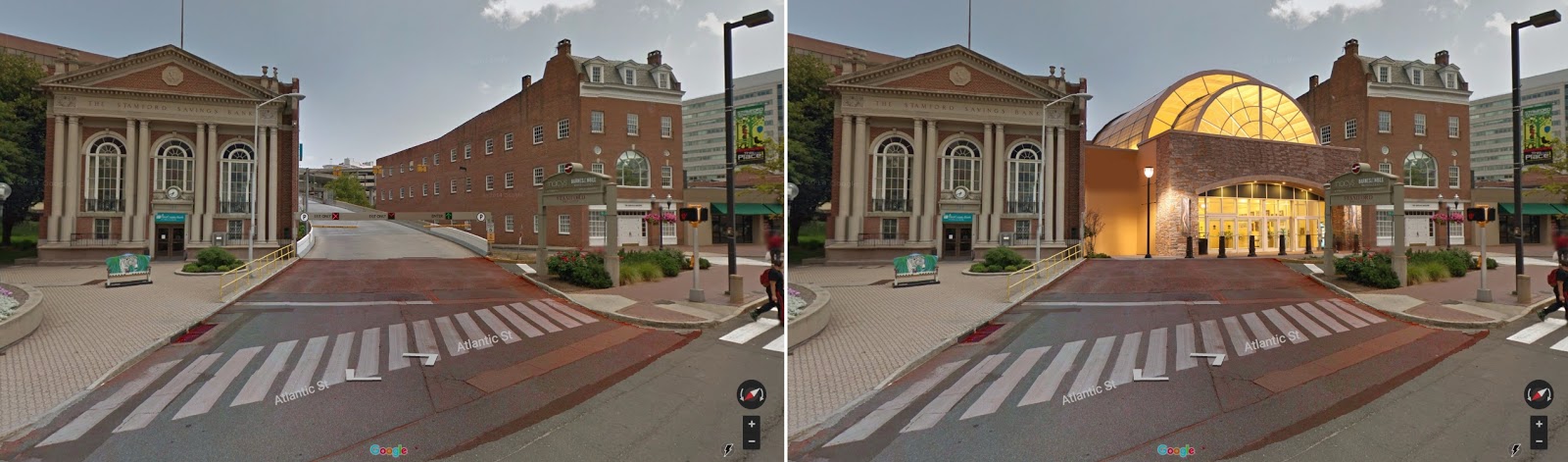
In the previous post, I showed one way the mall could be opened to the street by demolishing one of the car access ramps:

At present, left, and after new entrance.
Additionally, entrances could be punched into the mall at various other points on the exterior, as most parking is actually above the mall, and shopping can be accessed at most points directly from the street.

Narrowing Other Streets

Atlantic Street, onto which this mall entrance faces, should be narrowed from three to two lanes throughout its length with a bike lane added.  A shared space arrangement with bollards (bollards inside the bike lane) would be an ideal treatment.  A new street of 16' or so (not shown) should be run past the facades of these buildings, through the adjacent park, under the mall and into the remnant stub of the old Main Street.  Half of the overly-large park (really a paved square) should be sold off to private parties to construct new buildings along the southern boundary of this new street, leaving a still-large triangular square bounded on all sides by rights-of-way.  

The city should also use its power of eminent domain to open new streets and to complete those discontinuous fragments that already exist.  The below map shows existing streets in red, pedestrian paths in orange, and suggested new streets in yellow:


These new streets also include a pedestrian bridge over Mill River at the upper left, the new 16' street referenced before curving through the park, a new arcaded street through the mall, and two streets creating a three-part division of a large, partly unbuilt block at the right.  Other segments have been added here and there, and the continuation of Summer Street is visible in the center right.

Transportation

Regarding transportation, despite the likely high cost, it may be desirable to create a second stop in downtown Stamford at either Canal or Elm Streets or along East Main Street.  This would help convert the train system into a small localized rapid transit system, and has parallels elsewhere on the line with New Haven's State Street station, Bridgeport's planned second Barnum station and Fairfield's Metro station.  

A full infill station, complete with station house, was built in West Haven for $80 million, though the Bridgeport's station's cost appears to be nearly double that.  Since Stamford is the last stop for many express trains, it would not unduly interfere with express train operation.  An Elm Street or East Main Street station serving the Cove neighborhood and providing a secondary downtown route might be very popular and would not require much parking.  There is ample room for it, and the existing overpasses dating from the turn of the century, will need to be replaced sooner or later.


Optimistically, a plan like this would have a ten-year time-frame from initiation of planning to start of operation.

Parking

Parking is always one of the thorniest issues in downtown planning, but Stamford, for better or worse, is "blessed" with an abundant supply of garage parking.  In particular, the mall parking lot and the Target parking lot are greatly under-used.  In light of this parking supply, if parking minimums cannot be abolished entirely, the city should offer fee in lieu of parking to any residential developer who secures a parking arrangement with one of these local operators.  The number of spaces required to be secured should be as low as politically feasible.

It goes without saying that on-street parking rates should be dramatically increased in the downtown area.  The city is currently attempting to raise additional revenue by imposing new fees on outdoor dining spaces, yet the parking adjacent to it continues to be greatly underpriced.  Although I am generally opposed to on-street parking in areas with high pedestrian volumes, a Shoup-inspired approach that used increased fees for civic improvements could be a positive change.

What Not to Do

Stamford is currently undergoing a major redevelopment project in the Harbor Point area, a former mixed industrial and residential area in the South End of the city, west of the canal.  Although purportedly the handiwork of planners, the haphazard arrangement of streets and commercial spaces creates an environment which at best, is reasonably pleasant, but which at worst is less than the sum of its parts.  

Here are some examples of the decent, the bad and the ugly.  One of the newest areas features a semi-shared space street (interesting) with use of bollards (good), yet the space is overly large (not good) the architecture is completely cold and indifferent (not good) and the scene is altogether too busy with too many plantings (not good).  There are a couple of restaurants along the street to the left with outdoor seating, which greatly helps to enliven the area in the warmer months.


For contrast, here is a street in between two apartments, lined with garages and electric equipment.  This is an unpleasant and even dangerous street to walk down, and it is right off the main park square!


Most unforgivably, in another area close by, is this facade on the local neighborhood commercial main street.  I generally try to steer away from strong language so that readers may make up their own minds, but this is simply atrocious.  The street level must be done better than this.


There are many other changes large and small that one could consider throughout Stamford as a whole, and the city does seem to be engaged in a process of gradually narrowing intersections by bumping out sidewalks, thereby improving pedestrian safety.  With several recent and well-publicized deaths of pedestrians, this needs to be an immediate focus and priority.  Zoning needs to be reformed as well, but that is a post that I have already written.

Monday, December 21, 2015

That 70s Urbanism

1970s suburb, Birmingham, AL.
The 70s, as much as any decade from the 1920s to the 1990s, has gotten a bad rap in contemporary urban planning circles.  It was the golden age of the suburb and the nadir for many urban areas around the United States, not to mention a boom time for highway construction and the development of very low density suburbs on non-gridded street patterns.  Surely there is nothing we can glean from this time period that has applicability to the urbanism of today?

Well, this is perhaps not entirely true.  The 1970s, as well as the decade before it, arguably represented the first time in the urban history of America that planners self-consciously pursued entirely pedestrianized environments, although the inspiration for these areas went back to flights of imagination from the 1920s if not earlier, and the 1950s saw the genesis of several of these ideas, at least in their embryonic forms.    I refer not only to pedestrianized main streets, but to the five great pedestrian creations of the age: the enclosed shopping mall, the international airport, the vacation resort, the convention center, and the network of tunnels and/or skyways.  Each of these represented a vision, if incomplete, for pedestrian-only circulation and commerce on a grand scale, often on the footprint of a small town.  

Do I jest?  No.  The future, if the human imagination is a key to the future, was pointing toward pedestrianism in the 1960s and especially 1970s.  This was, after all, the age of Paulo Soleri's implicitly pedestrian-centric arcology.  Gas prices were soaring by the early 70s.  The 1939 World's Fair vision of high-speed highways was out, and a more refined tecnho-utopianism involving futuristic megastructures was in.  The great majority of the buying public rejected this vision for their private lives, but as the success of enclosed malls shows, they gladly embraced it in many other contexts -- in commerce, for employment, in travel and for recreation.  

The arcology: no highways here, or at least, not the central element! Source.
The tunnel system of Houston and the skyway system of Minneapolis, both begun in earnest in the 1960s, were built out through the 1970s.  Enclosed mall construction, which began in 1956, was in such a boom that four enclosed malls opened from 1969 to 1980 in the city of Toledo, Ohio alone.  Air travel multiplied through the 1960s and airports were expanded on an unprecedented scale.  The very idea of the convention center, although it had been around for decades, attained gargantuan scale by the latter half of the 20th century.  

The hostility toward these type of environments in recent years, has, it seems to me, been based on two primary grounds: 1) the environments, being private and privately controlled, are corporate and sterile; and 2) although the environments themselves may be pedestrian, they are dependent for their business on car-driving customers.  Of these two critiques, however, the second is not inherent to the form of the structures themselves.  Rather, a pedestrian environment such as a tunnel system or an enclosed mall is, as the cities of Japan or Korea bear witness, a better partner to transit and walking trips than it is to car transport.  That the United States largely squandered its opportunities to integrate these structures and systems into its transit networks is an indictment of city planning, but not necessarily of these forms themselves.  

The Japanese, arguably the best city-builders in the world, have not missed this point, and typically have built shopping malls either adjacent to or, in the case below, on top of railway stations:

Osaka's Keihan Mall, over the Kyobashi railway station. Bing Maps.
In the case of American cities, even where the option is obvious and available, no such plans are made.  In Stamford, Connecticut, where nearly the entire downtown was condemned and bulldozed in a vast urban renewal scheme, the new enclosed mall built by the city's hand-picked developer was inexplicably not located next to the city's heavily-used Metro North railway stop:

The mall, at top right, and station, at bottom left.  Bing Maps.
What were they thinking, one could ask.  Note also the very low value placement of the interstate highway just north of the railway line, although this area probably had higher property values than the south side of the tracks at the time of the highway's construction.  In truth, the Stamford planners had given up entirely on any idea of pedestrian circulation outside the new megablocks.  The curated spaces within the new mall were designed to be accessed by car alone, and the structure to this day presents a fortress-like appearance to the outside.  The decision cannot even be explained by a desire to exclude train riders, who then and now tend to be well-heeled commuters to New York and are in general better off than most.

Had the planners of the 1970s left the city alone, and simply redeveloped the train station as a mall, who knows what might have happened by today?  Yet these questions need not be hypotheticals.  Cities have the power to make these changes today.  Stamford cannot move its mall, but it can consider a new infill station closer to it.  It can consider how to improve pedestrian mobility.  It can revamp its bus network.  It can do many things to address past mistakes, but it must be able to understand its mistakes, and even more importantly understand how these creations of the 1960s and 1970s can be a force for good, not merely magnets for a car-driving public.

There are a few easy steps that can be taken at first.  If Stamford wants to fix its mall, tear down one of the car ramp entrances, already duplicated by two others, and install a prominent pedestrian entrance, like so:


Easy?  In the grand scheme of things, yes.  Expensive?  Not terribly.  A bolder step would be an entirely new infill station, one closer to the mall, perhaps at one of the locations highlighted with a green arrow:


Plan a new station.  New Haven already did it, twice, and Bridgeport is doing it, so this need not be some impossible fantasy.  The overpasses need to be replaced anyways, so merge the projects.  Use the gains in real estate value to improve pedestrian connections.  Narrow the streets.  Add bike lanes.  It need not be that difficult!

If hostility toward the idea of enclosed malls, or skyway systems, or convention centers is retained, however, then cities may or may not succeed at revitalization, but they will squander again an opportunity to use these forces for good rather than ill.

---------------

Other reading:

See Mallville by Andrew Price for a related perspective on the traditional city aspects of the American mall.