Showing posts with label Mexican Urbanism. Show all posts

Saturday, February 27, 2016

American Zoning as an Expression of Nativism

It's possible to advance many explanations for the rise of zoning in the United States in the 1920s: classism, resurgent racism, reaction to rising vehicular traffic, the failure of restrictive covenants and many more.  While all of these reasons, among others, have some explanatory power, for me they fail to adequately account for the unique and distinguishing features of American zoning as described by author Sonia Hirt, namely, the establishment of exclusively residential zones as well as the creation of single-family detached zones.

A possible alternative explanation is that these specific features were motivated by and in reaction to many of the same conditions that gave rise to the immigration restriction movement which came to prominence at nearly the exact same time.  For example, the village of Euclid's zoning ordinance, which led to the Supreme Court case of the same name, was adopted in November 1922, slightly more than a year after the Emergency Quota Act of 1921 was enacted.  Restrictionist currents were running very strongly throughout the nation at the very time that cities busied themselves passing zoning laws.

Now, one fact that may surprise is that immigrants at the turn of the century actually had higher homeownership rates than the native population.  This chart, compiled by economist Richard Sutch in a recent paper, depicts homeownership by city size in 1900 among the native-born and foreign-born, showing that the foreign-born had substantially higher homeownership in virtually all cities and city sizes apart from New York (the entry point for many immigrants), where the difference was nonetheless small:

How, or why, did the foreign-born achieve relatively high rates of ownership? Sutch speculates that immigrants valued property ownership due to "the importance of acquiring a life-cycle stock of wealth because of an inability to rely upon distant family members, the larger community, or co-ethnic neighbors for protection in old age."  Contrarily, in From Cottage to Bungalow, Joseph Bigott writes about ethnic savings and loan entities in turn-of-the-century Chicago and how these offered greater financial flexibility, in some sense, to new immigrants.

What seems to be generally agreed on is that immigrants, more so than natives, embraced small multifamily dwellings and home commercial uses, whether as simple as a chicken coop in the backyard or as elaborate as an entire storefront added onto a single-family home.  Jacob Wegmann, writing in What Happened to the Three Decker, quotes a developer as noting that the small multifamily dwelling provides "a way for working class folks with no established assets to obtain an owner-occupied residence." Additionally, he writes:
"[I]mmigrant families, many of them already the owners of small businesses, were likelier to be undaunted by the extra risks and work posed by being small landlords, such as the need to build up cash reserves to cover loan payments in the event of vacancy of the rental apartment. Additionally, partially due to Chicago’s characteristic clustering by nationality, many immigrant families have an extensive network of acquaintances from the same ethnic group to draw upon as a pool of potential tenants, and for whom credit and character checks can be undertaken in a verbal, informal manner via social contacts."
The small business and the multifamily dwelling were, in that sense, the gateway to prosperity for many immigrants, as well as a gateway to homeownership, around 1900 and continuing even today.  Given that reality, I think the observer of history should find it very odd how central a position American zoning gave to the exclusion of commercial uses from residential areas and the banning of multifamily uses from large areas of entire cities, particularly when other countries not so well-known for their elevation of so-called property rights embraced neighborhood commercial as a desirable and positive social good. 

Small SF and multifamily housing with added restaurant/retail, Port Chester, NY.
I do not know what the position of Edward Murray Bassett, the father of American zoning, was on immigration.  His autobiography is virtually impossible to obtain.  His writings available online do not directly mention it.  I would perhaps give him the benefit of the doubt.  The motives of many of his contemporaries, however, are not in doubt, as Seymour Toll wrote in 1969 in Zoned American:  
"The [laundry] controls were an expression of the hatred and antipathy which San Franciscans were directing against the Chinese, trying to force them to quit the city. The immigrant is in the fiber of zoning.  He first appeared as an Oriental.  In early twentieth-century New York he is seen as a southeastern European, the lower East Side garment worker who presence in midtown Manhattan created one of the decisive moments in the history of zoning."
None of this is terribly new or controversial.  A connection that hasn't been made as clearly is how single-family zoning and the total exclusion of commercial uses were specifically targeted at the immigrant businesses and housing options described above.  A newly-arrived immigrant (and most people in general) did not have the capital to construct an entire "mixed use" building.  After some time, though, he might be able to add a very small commercial addition onto an existing building, as shown in the photo above, or convert the first floor into a storefront.  Zoning would forbid this development in two ways: first, by instituting setbacks, and secondly by eliminating commercial uses altogether.  Even native residents needed commercial uses in close proximity, but these were to be relegated to special corridors where competition would be greater and immigrants would have more difficulty gaining a toehold.  

With respect to residential buildings, the banning of small multifamily buildings from much of the city foreclosed the route to homeownership previously mentioned.  A century after New York's zoning code was adopted, the numbers have flipped, and the native born are much more likely to be homeowners than the foreign born (67% to 52%, according to the Census).  The financial benefits of homeownership, moreover, have been concentrated in the hands of the upper middle class, the original backers of zoning.

It is only antipathy to immigrant populations that I think can explain these dual features of almost all American zoning codes, and their absence from the codes of most other countries.  The apparent trauma of early 20th century immigration led Americans, or at least a vocal portion of them, to shred their traditional respect for individual property rights and institute special zones which reflected native middle-class values and conceptions of proper living conditions.  The loss of neighborhood shops, or affordable rentals, were unfortunate but necessary casualties of this process.  Elsewhere in the world, the process of commercial conversion can still be watched unfolding, as below in Mexico.

Shopfront in setback, contemporary Guadalajara suburbs, Mexico.
I am not certain, though, that the alliance against shops and multifamily dwellings was ever as unified as it was made out to be.  Then, as now, the loudest and shrillest voices probably carried the day.  Many natives would have liked to have run businesses out of their homes as well, although the importance of multifamily housing a means to ownership waned with the arrival of new forms of mortgage finance in the 1920s and especially 1930s.  

While times have changed, the rolling back the restrictive laws of the 1920s would pay dividends even today.  

Related posts: 


Saturday, October 4, 2014

Housing Innovations in Texas

Citylab recently posted an interesting profile of a new development in Harlingen, Texas by Amanda Kolson Hurley.  Having written about this area of the country earlier this year, I was curious to take a closer look at the development, which appeared to take some design cues from the Mexican urbanism that is just a short ride away from this border region.

An aerial view of the development, La Hacienda Casitas, shows it set among mobile home parks that are very common in Harlingen.  These homes, however, are site built, and use lots as small as 1,800 square feet, which is similar to the lots sizes found in the new developments of Matamoros, Mexico.  Streets range from 16 to 22 feet wide, with some on-street parking:


The more I looked around Harlingen, the more this particular development stood out: overwhelmingly, new development in the city consists either of mobile home parks or much larger suburban homes of the type found in sunbelt cities across the United States.  It was a pattern I'd seen before, in Bradenton, Florida, where the city's zoning code divided single-family housing into two types: large lot, site-built suburban and small-lot, manufactured and/or mobile.  Could land use in Harlingen be governed by similar provisions?

Fortunately, the city puts its zoning ordinance and map online in an easy-to-navigate format, so finding residential lot minimums was not difficult:


Here we see that Harlingen, like Bradenton, establishes a minimum lot size for lots in mobile home parks that is less than half that required in the single-family "R1" zone.  In fact, the ratio between the two zoning categories is nearly the same in both cities (Harlingen: 6000/2400 = 2.5 vs. Bradenton: 7200/3000 = 2.4).  Unlike Bradenton, Harlingen does not seem to establish minimum sizes for the dwellings themselves, although setback and lot coverage requirements impose effective maximums that are most restrictive on very small lots.

How well the city holds developers to the limits I cannot say for sure, although most lots in developments platted within the last 20 years appear to be between 6,000 and 7,000 square feet. On first blush the "Planned Development" zone appears to provide some flexibility, but it requires the developer to own a parcel of at least five acres, leaving it unavailable to small-scale builders designing infill projects.  Townhouses are also an option, but are not permitted by right in R1 zones.

In any event, the disparity between zones again appears to create a binary pattern of real estate prices, with new site-built homes on large lots averaging around $145,000, and manufactured homes only $45,000 or so.  Thanks to zoning-abetted filtering*, some site-built homes can be bought for no more than $60,000 to $70,000, but these tend to be of very low quality or on much smaller lots that seem to have been grandfathered in under the present zoning code.  This mandated land consumption obviously contributes to a low-density pattern of urban growth, and also illustrates how zoning's affordability and quality of life impact isn't limited to large coastal metros.  Harlingen's affordability safety valve, the mobile home district, establishes what is in effect a physically segregated zone for low-income, market-rate housing where even the homes themselves are forbidden from being site-built.

Homes in La Hacienda Casitas. Credit: bcWorkshop.
In light of all this, was the La Hasienda Casitas project an attempt to circumvent the code with a development of houses on tiny lots and narrow streets, thereby making occupancy (the homes appear to be rentals, at least for now) of new, freestanding and site-built homes available to low-income families of Harlingen?  Kolson Hurley's article discusses the intensive coordination and grant-seeking between and among architect bcWorkshop and non-profit housing developer Community Development Corporation of Brownsville needed to bring the project to fruition, but I have to wonder whether regulatory barriers, rather than anything inherent in the design and construction of this project, is what is standing in the way of adoption of the style by for-profit developers.


*Zoning-abetted in that the restriction of centrally-located lots to single-family use effectively caps land values, allowing the physical deterioration of the housing stock to play the predominant role in establishing property values.

Related posts:
Mobile Home Impediments and Opportunities
Cross-border Urbanism: From Texas to Tamaulipas

Sunday, February 23, 2014

Cross Border Urbanism: From Texas to Tamaulipas

Although the American and Mexican urban traditions have at various times shared some fundamental similarities, including a heavy use of orthogonal grids and an apparent tendency toward single-family homes sitting on their own lots, the different manner in which these have been carried out in each country have produced strikingly dissimilar urban landscapes.

Nowhere is this more evident than with the sister cities of Brownsville and Matamoros, facing each other across the Rio Grande river. Demographically and economically they have much in common: the 2010 Census indicates that over 85% of Brownsville's population is of Mexican ancestry and Spanish-speaking, and although Brownsville is wealthier than Matamoros, it is very poor by American standards, having recently replaced McAllen as the poorest city in the nation. The Mexican state of Tamaulipas, by contrast, is wealthier than the Mexican average.

Matamoros at left, Brownsville at right. From Google Maps.
The economic and demographic convergence at the border might suggest a gradual transition in urban form, but instead there is abrupt break at the Rio Grande river, as can easily be seen above (the map has been rotated clockwise). Matamoros is a city that makes almost exclusive use of attached or nearly attached dwellings on small lots, while Brownsville has a quintessentially American pattern of detached houses sitting on much larger lots.

A typical house lot in a newer neighborhood of Matamoros has only around 1200 square feet, while in Brownsville, new subdivisions have lots around 5400 square feet. Interestingly, the lot size trends appear to be diverging: Matamoros' new lots are smaller than those in older parts of the city even as car ownership has soared, while Brownsville's are much larger. Older areas of both cities, dating back to the late 1800s or early 1900s, both tend to have house lots of around 3,000 square feet, although in different configurations (Matamoros, for instance, never used rear alleys).

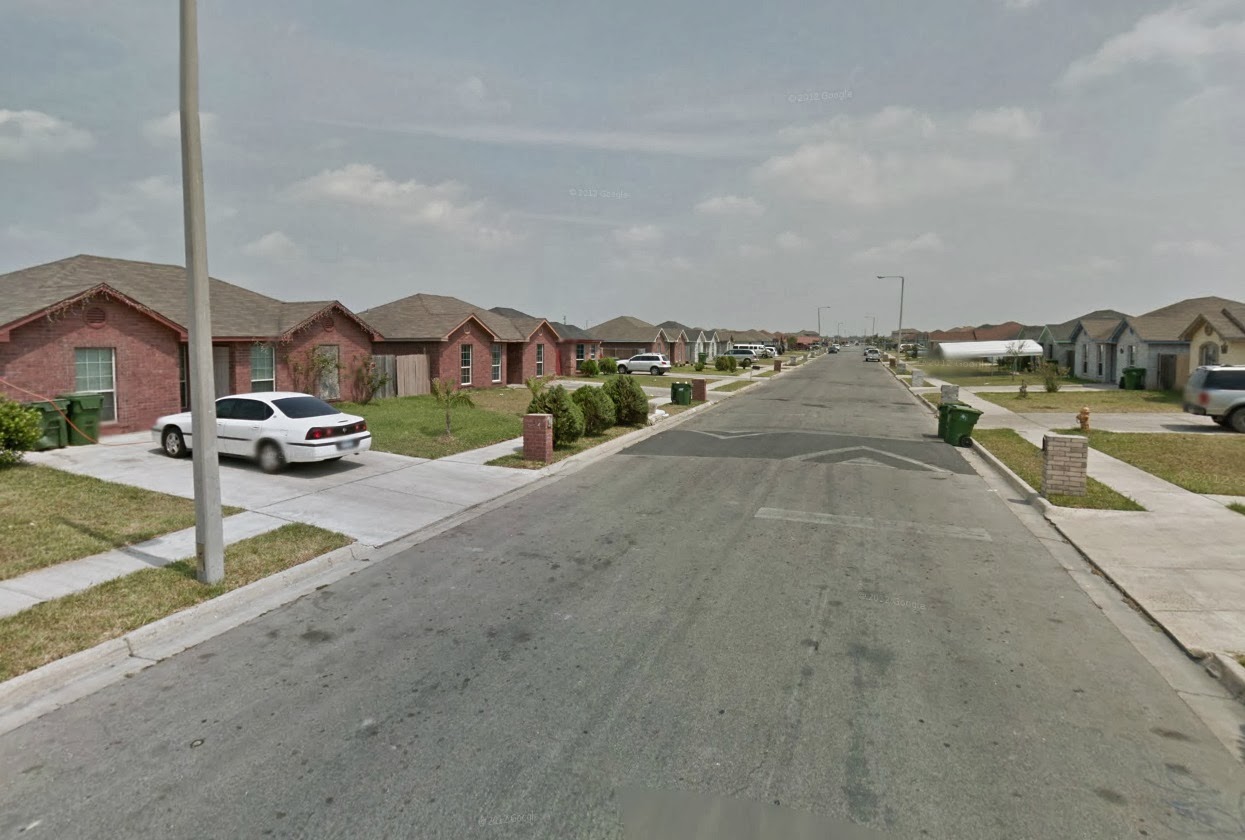
Contemporary subdivision street in Brownsville. Google Maps.
New homes in Matamoros are often tiny, in some cases little more than 500 square feet, but appear to be mere placeholders for expansion. Usually set back about 15-20 feet from the lot line, these homes are swiftly expanded forward into the setback and up a story or two using simple construction techniques, with the result that after no more than a decade or so, the street's appearance is completely transformed, and no longer appears mass-produced. (Single-use zoning seems to be unknown or unenforced, as numerous small commercial establishments can be seen cropping up, mid block, along these streets.)

Mexican "snout house" in Matamoros, expanded from the developer's
original house of the type still visible to the right. Google Maps.
Expanded in this way, a very small home can grow to perhaps as much as 1000-1500 square feet. Persons desiring even larger homes could, presumably, simply buy adjoining lots and combine them.

This fundamental difference in lot size has major implications for the size of the urban area. Matamoros, with a 2010 population of 489,000, actually occupies slightly less area (28 sq. mi.) than Brownsville's 175,000 (29.9 sq. mi.), based on a mapping out of residential urban boundaries in each case. It also must have some implications for home prices: while Brownsville homes are much cheaper than the American average with a median home price of $130,000 for what is typically a three bedroom home, a relatively large Matamoros starter home (915 square feet over two stories on an 1130 square foot lot) can be had for only $34,000. The tiniest of the starter homes, no bigger than a studio or micro-apartment, are as little as $10-15,000. This suggests that a new two-bedroom home in Matamoros can be purchased for approximately what the down payment would be for a typical three bedroom home in Brownsville, and helps explain Mexico's very high homeownership rate. Finally, it has implications for mixing of uses, since the dense packing of houses allows for businesses to thrive on foot traffic, reducing the political pressure for parking minimums that would, even in the absence of zoning, effectively ban businesses on tiny lots.

The economic, financial, geographic, historical, cultural and legal factors that have led to such divergent patterns of urban growth aren't easily or quickly summarized, but the different outcomes are clear enough.

Related posts: Check out Apex Urbanism, which has a series of posts featuring various Mexican cities.